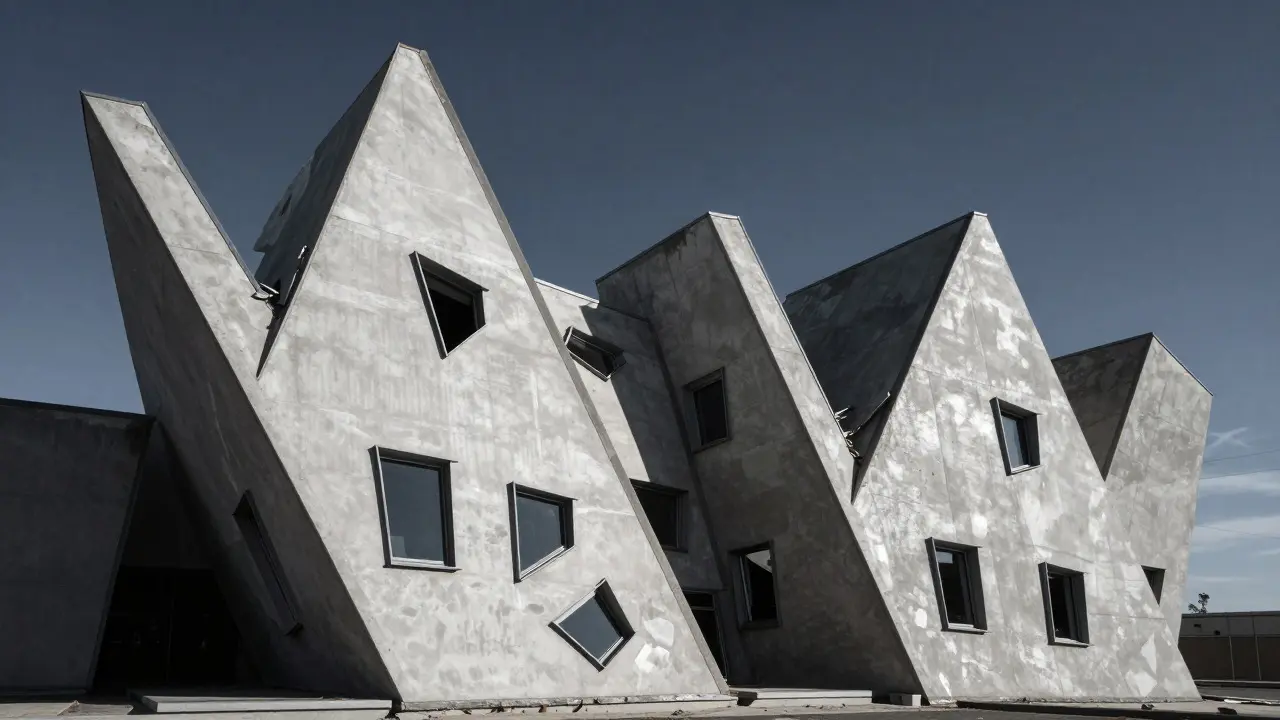
Look at a building that seems like it is falling apart. The walls lean at weird angles. The roof looks like a jagged mountain range. The windows are scattered randomly, ignoring the rules of symmetry you learned in school. You might think something went wrong during construction. But what if I told you this chaos was the plan all along? This is Deconstructivism, a style that challenges how we see structure, stability, and beauty.
We often expect buildings to be boxes. We want straight lines, right angles, and clear functions. Deconstructivism throws those expectations out the window. It takes the basic elements of architecture-walls, floors, roofs-and breaks them apart. Then, it reassembles them in ways that feel unpredictable, dynamic, and sometimes unsettling. If you have ever walked past a building that looked like a frozen explosion, you have seen deconstructivism in action.
The Roots of Breaking Rules
To understand why these buildings look the way they do, we have to look back at the philosophy behind them. Deconstructivism did not start with architects drawing crazy sketches. It started with philosophers questioning language and logic. In the late 1980s, a group of thinkers led by Jacques Derrida argued that meaning is never fixed. They believed that structures, whether in books or buildings, contain internal contradictions. These contradictions can be exposed by taking the structure apart.
When this idea hit the architectural world, it caused a stir. Architects began to ask: Why must a wall stand straight up? Why must a floor be flat? In 1988, the Museum of Modern Art in New York hosted an exhibition called "Deconstructivist Architecture." This event put the spotlight on seven architects who were already experimenting with fragmentation. The show included work from Frank Gehry, Zaha Hadid, and Daniel Libeskind. This moment marked the official birth of the movement as a recognized style.
It is important to note that deconstructivism is not just about making things look messy. It is a reaction against modernism. Modernist architecture, popular in the mid-20th century, focused on function, simplicity, and clean lines. Think of glass towers and white concrete blocks. Deconstructivists felt this approach was too rigid. They wanted to introduce complexity, tension, and emotion into their designs.
Key Characteristics of Deconstructivist Buildings
If you want to spot a deconstructivist building, look for specific visual cues. These buildings share common traits that set them apart from traditional styles. Here is what makes them unique:
- Fragmentation: The building appears broken or disjointed. Parts seem disconnected from each other, creating a sense of instability.
- Non-Rectilinear Shapes: Straight lines are rare. Instead, you will see curves, twists, and sharp angles that defy gravity.
- Distorted Proportions: Walls may be too thin or too thick. Windows might be placed oddly high or low. The scale feels off, intentionally challenging your comfort.
- Controlled Chaos: While the exterior looks chaotic, the interior is carefully planned. Every piece has a purpose, even if it does not follow standard rules.
- Unpredictable Surfaces: Materials are used in unexpected ways. Metal might twist like ribbon. Concrete might crack deliberately. Glass might shatter visually without breaking physically.
These characteristics create a powerful emotional response. Some people find these buildings exciting and inspiring. Others find them confusing or even ugly. That reaction is exactly what deconstructivists aim for. They want to provoke thought, not just provide shelter.
Famous Examples Around the World
Theory is interesting, but seeing real examples helps bring the concept to life. Several iconic buildings showcase the power of deconstructivism. Let us look at three standout projects that define the style.
| Building Name | Architect | Location | Year Completed | Key Feature |
|---|---|---|---|---|
| Guggenheim Museum Bilbao | Frank Gehry | Bilbao, Spain | 1997 | Titanium-clad curves resembling ship hulls |
| Jewish Museum Berlin | Daniel Libeskind | Berlin, Germany | 2001 | Zigzagging zig-zag form representing absence |
| Heydar Aliyev Center | Zaha Hadid | Baku, Azerbaijan | 2012 | Fluid, wave-like facade with no sharp corners |
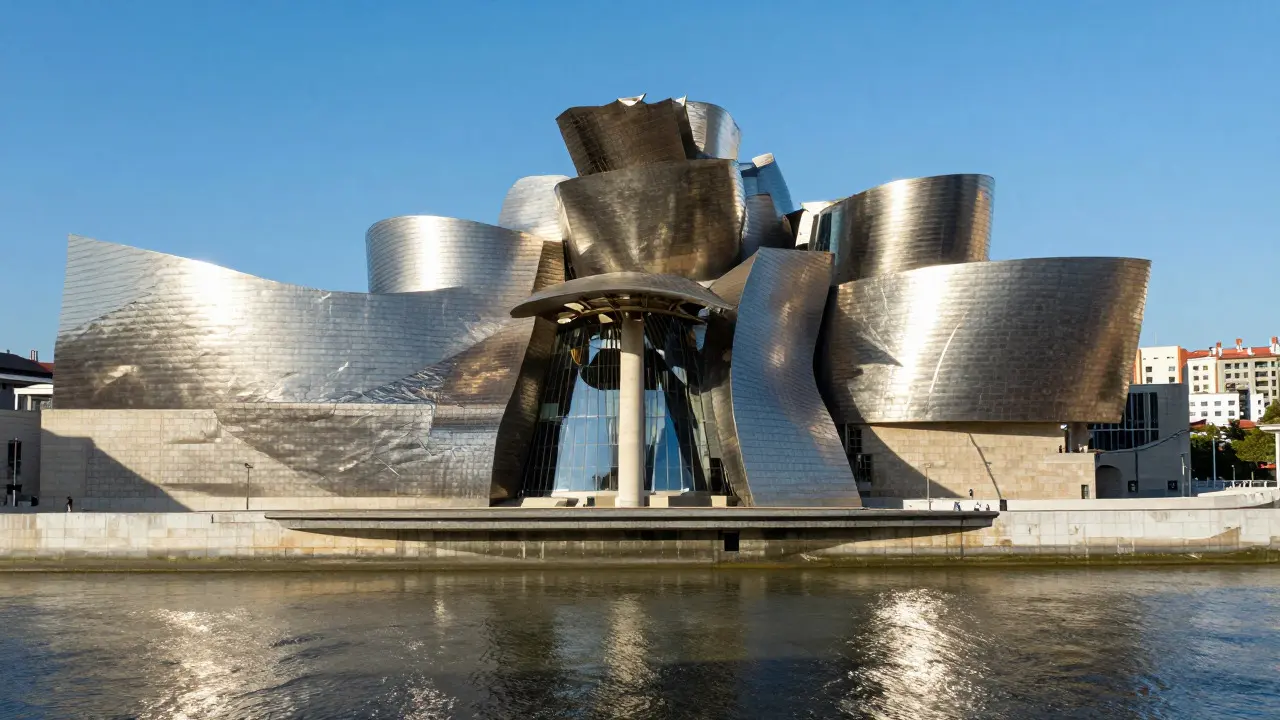
The Guggenheim Museum in Bilbao is perhaps the most famous example. Designed by Frank Gehry, its shimmering titanium skin reflects the sky and water. The building looks like a cluster of crumpled metal sheets. When it opened, it transformed the city of Bilbao from an industrial hub into a cultural destination. This phenomenon became known as the "Bilbao Effect," where a single striking building revitalizes an entire area.
In contrast, the Jewish Museum in Berlin tells a darker story. Daniel Libeskind designed the museum to represent the void left by the Holocaust. The building’s shape is a jagged line that cuts through the ground. Inside, visitors walk through narrow corridors that end in empty spaces called "voids." These empty rooms symbolize loss and memory. The architecture itself becomes a narrative tool, guiding emotions rather than just housing exhibits.
Then there is the Heydar Aliyev Center in Baku. Zaha Hadid, often called the Queen of the Curve, pushed deconstructivism further. Her design eliminates all sharp angles. The building flows like liquid concrete, merging seamlessly with the landscape. It shows how deconstructivism can evolve from fragmented chaos to smooth, organic movement.
The Technology Behind the Madness
You might wonder how architects actually build these impossible shapes. In the past, complex geometry was nearly impossible to construct. Builders relied on simple tools and materials. Today, technology has changed everything. Computer-Aided Design (CAD) software allows architects to model intricate forms with precision. Programs like Rhino 3D and Grasshopper enable parametric design, where algorithms generate complex patterns automatically.
This technological leap is crucial. Without digital tools, deconstructivist buildings would remain drawings on paper. Engineers use advanced simulations to ensure that twisted steel beams and leaning walls stay standing. They calculate wind loads, seismic activity, and material stress in ways that were unimaginable thirty years ago. So, while the buildings look chaotic, they are held together by rigorous science and math.
However, this reliance on technology comes with costs. Deconstructivist projects are often expensive and time-consuming. Custom materials and specialized labor drive up prices. Critics argue that these buildings prioritize form over function, spending millions on aesthetics while neglecting practical needs like energy efficiency or accessibility.
Criticism and Controversy
Not everyone loves deconstructivism. The style has faced significant backlash since its inception. Some critics call it elitist, arguing that only wealthy clients can afford such extravagant designs. Others claim it ignores human scale, creating spaces that feel alienating rather than welcoming.
One major criticism is sustainability. Many deconstructivist buildings use large amounts of steel, glass, and concrete, which have high carbon footprints. Their irregular shapes can also make heating and cooling inefficient. As the world moves toward greener architecture, some question whether deconstructivism has a future. Can chaotic forms coexist with eco-friendly goals?
Another concern is maintenance. Complex facades require special cleaning and repair techniques. The titanium panels on the Guggenheim, for instance, need regular upkeep to maintain their shine. Over time, weathering can alter the intended appearance, raising questions about longevity.
Despite these criticisms, deconstructivism remains influential. It has inspired new generations of architects to experiment with form and space. Even if not every project embraces full deconstruction, the mindset of breaking rules persists in contemporary design.

Is Deconstructivism Still Relevant Today?
In 2026, the architectural landscape continues to evolve. Smart cities, sustainable materials, and modular construction dominate headlines. Does deconstructivism still have a place? Yes, but in modified forms. Pure deconstructivism is less common now, but its influence is everywhere. Look at recent stadium designs, airport terminals, or luxury hotels. You will see curved surfaces, asymmetric layouts, and bold statements that trace back to the deconstructivist pioneers.
Moreover, the integration of AI in design is bringing a new wave of complexity. Algorithms can now generate forms that mimic natural processes, echoing the organic unpredictability of early deconstructivist works. The difference is that today’s tools allow for greater efficiency and customization. Architects can test thousands of variations quickly, finding optimal solutions that balance aesthetics and performance.
For students and professionals, understanding deconstructivism offers valuable lessons. It teaches us to challenge assumptions, embrace ambiguity, and push boundaries. Whether you love or hate the style, it forces us to rethink what architecture can be.
How to Appreciate Deconstructivist Architecture
If you visit a deconstructivist building, try approaching it with an open mind. Do not judge it solely by traditional standards of beauty. Instead, consider these questions:
- What emotions does the building evoke? Does it feel tense, energetic, or mysterious?
- How does the building interact with its surroundings? Does it clash or complement the context?
- What story is the architect trying to tell? Is there a historical, cultural, or personal message embedded in the form?
- How does the space affect your movement? Are you guided, surprised, or disoriented as you walk through it?
Appreciation does not mean liking. It means understanding the intent and effort behind the design. By engaging critically, you gain a deeper insight into the creative process. You start to see architecture not just as shelter, but as art, philosophy, and engineering combined.
What is the main goal of deconstructivism in architecture?
The main goal is to challenge conventional ideas of order, stability, and harmony. Deconstructivism seeks to expose the underlying tensions and contradictions in architectural structures, creating spaces that provoke thought and emotion rather than simply providing functional shelter.
Who are the most famous deconstructivist architects?
Key figures include Frank Gehry, Zaha Hadid, Daniel Libeskind, Peter Eisenman, Bernard Tschumi, Rem Koolhaas, and Coop Himmelb(l)au. These architects gained prominence after the 1988 MoMA exhibition that defined the movement.
Is deconstructivism the same as brutalism?
No, they are distinct styles. Brutalism emphasizes raw concrete, massive forms, and functional honesty. Deconstructivism focuses on fragmentation, asymmetry, and complex geometries. While both reject classical ornamentation, their approaches and visual languages differ significantly.
Why are deconstructivist buildings so expensive?
Costs are high due to custom materials, complex engineering requirements, and specialized labor. Standard construction methods cannot handle irregular shapes, so each component often needs individual fabrication and precise installation, driving up expenses.
Can deconstructivism be sustainable?
It is challenging but possible. Traditional deconstructivist designs often waste energy due to irregular shapes. However, modern advancements in green technology and parametric optimization allow architects to create efficient, eco-friendly deconstructivist buildings that minimize environmental impact.