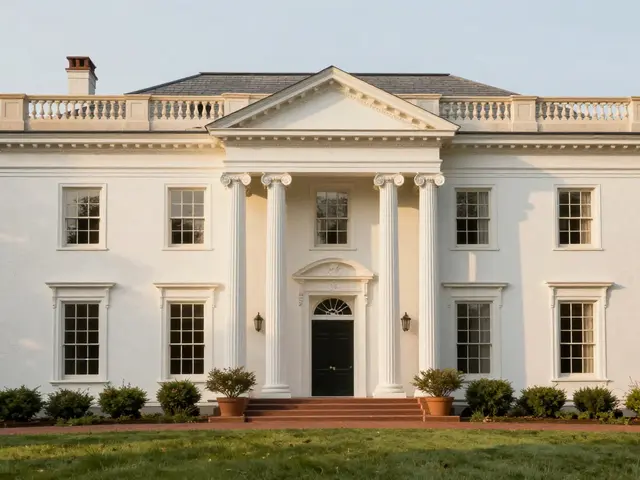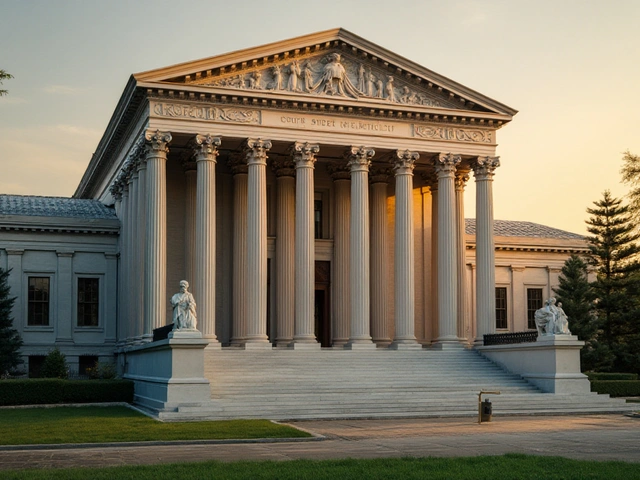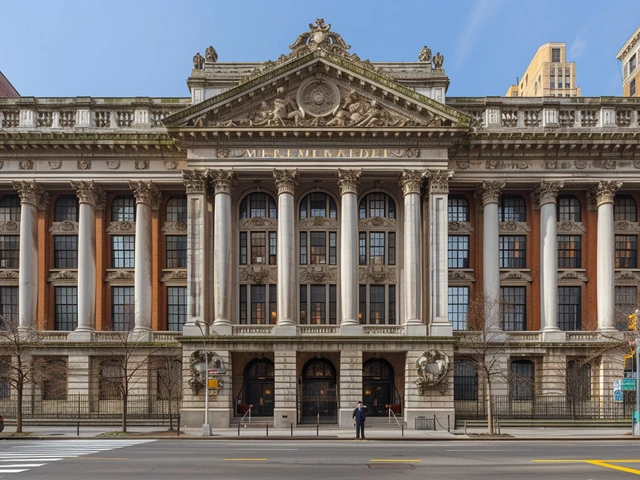
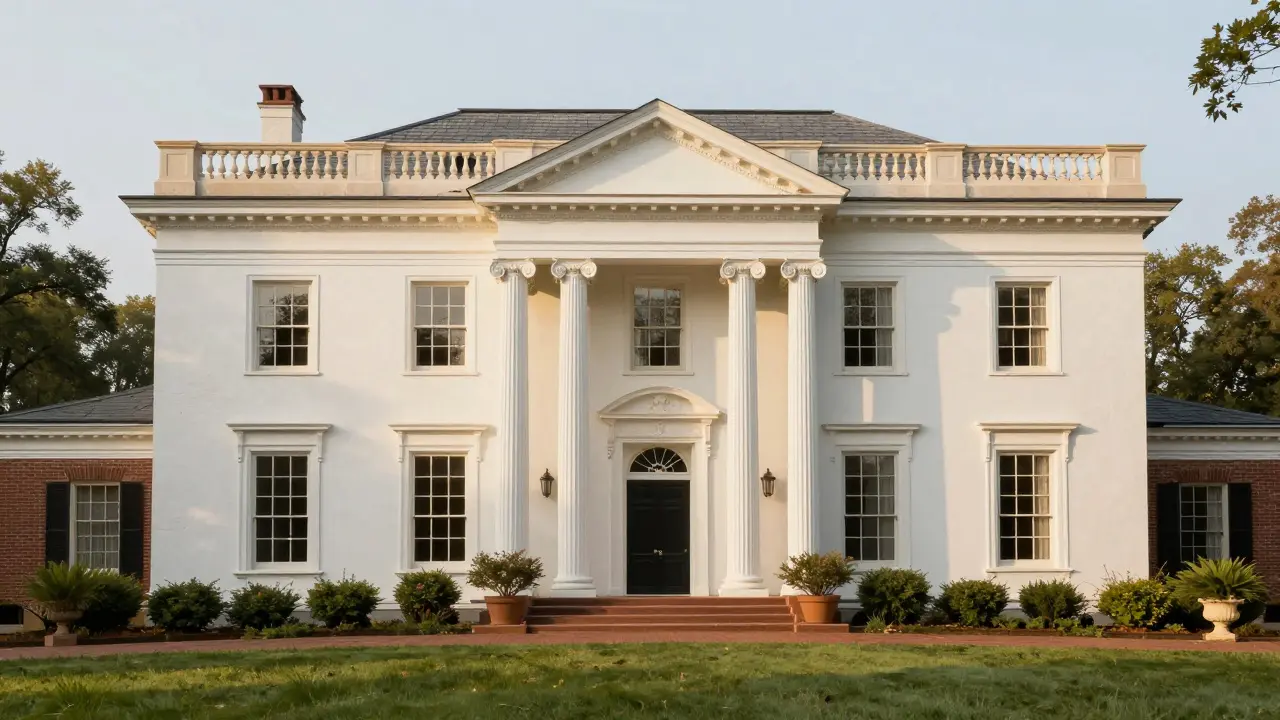
Walk past a white-columned building in Washington, D.C., or step into the grand foyer of an old plantation house in Virginia, and you are likely standing inside Federal architecture, which is an architectural style that dominated the United States from roughly 1780 to 1830, characterized by symmetry, classical details, and refined elegance inspired by ancient Rome and Greece. It is more than just pretty columns; it was a deliberate political statement. After breaking away from Britain, America needed a visual identity that said, "We are not colonial subjects anymore; we are citizens of a new republic."
This style didn't appear out of thin air. It evolved directly from the earlier Georgian architecture but stripped away the heavy, dark ornamentation associated with British monarchy. Instead, it embraced lightness, proportion, and democratic ideals. If you want to understand early American history, you have to look at these buildings. They tell the story of a nation trying to define itself through stone, brick, and wood.
The Roots: From Georgian to Federal
To get where Federal architecture ended up, you have to start with its parent: Georgian architecture. During the 1700s, most American elites copied British designs. These houses were boxy, symmetrical, and often featured heavy wooden moldings. But as the Revolutionary War ended, the mood shifted. Americans looked toward Europe, but specifically to the intellectual hubs of France and Italy, where the rediscovery of ancient Roman ruins was sparking a revival of classical forms.
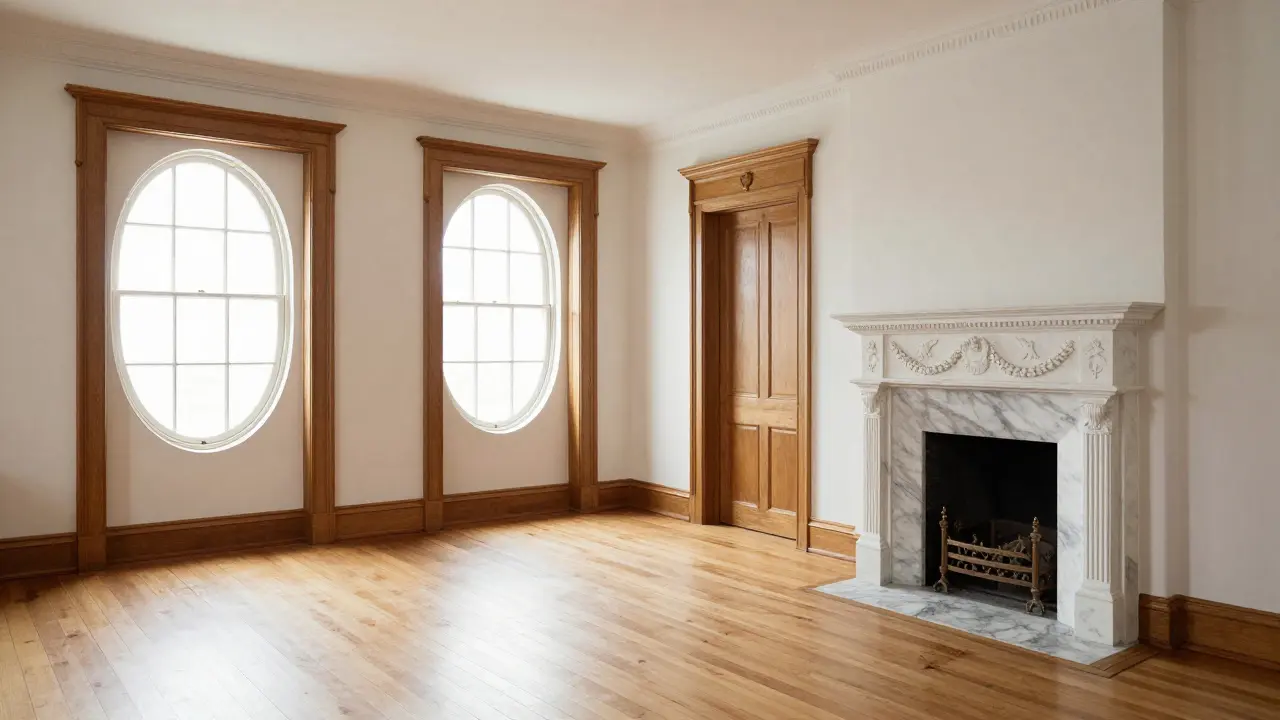
Federal architecture differs from Georgian style by replacing heavy, rustic detailing with lighter, more delicate motifs inspired by ancient Roman temples, such as fanlights, elliptical windows, and slender columns. Think of it as the difference between a sturdy workhorse and a sleek racehorse. Both serve a purpose, but one is built for power and endurance, while the other is built for grace and speed. In architecture, this meant moving from thick, chunky cornices to thin, elegant entablatures. The goal was refinement. The goal was to show that the new American elite were cultured, educated, and connected to the great civilizations of the past.
Key Features You Can Spot Instantly
You don’t need an architecture degree to spot a Federal-style building. Once you know what to look for, they stand out clearly. Here are the specific attributes that define the style:
- Symmetry: The facade is perfectly balanced. If you draw a line down the middle, the left side mirrors the right. Windows align vertically and horizontally.
- Classical Details: Look for pediments (triangular gables) over doors and windows. These mimic the fronts of Greek temples.
- Fanlights and Transoms: Semi-circular or elliptical windows above doors let in light and add a decorative touch. This was a major upgrade from the simple rectangular transoms of the Georgian era.
- Slender Columns: Instead of heavy pillars, Federal buildings use thinner, often paired columns made of brick or wood. They might be Ionic (with scroll capitals) or Doric (plain), but they are always graceful.
- Low-Pitched Roofs: The roofs sit low on the building, often hidden behind a balustrade (a railing) at the top. This makes the structure look wider and more grounded.
- Interior Elegance: Inside, you’ll find wide-plank hardwood floors, marble fireplaces, and plaster walls. The doorways often feature elaborate surrounds with garlands, eagles, or urns carved into the wood.
These features aren't random. They are designed to create a sense of order and calm. In a time of political upheaval, these buildings offered stability. They said, "Here, there is logic. Here, there is balance."
The Masterminds Behind the Style
No architectural movement happens without key figures. In the case of Federal architecture, two names dominate the conversation: Charles Bulfinch, an American architect who helped shape the skyline of Boston and later served as the Architect of the Capitol in Washington, D.C., introducing neoclassical elements to government buildings and Thomas Jefferson, the third U.S. President and amateur architect who designed his home Monticello and the University of Virginia, heavily influencing American academic and civic architecture with his interpretation of Palladian and classical styles.
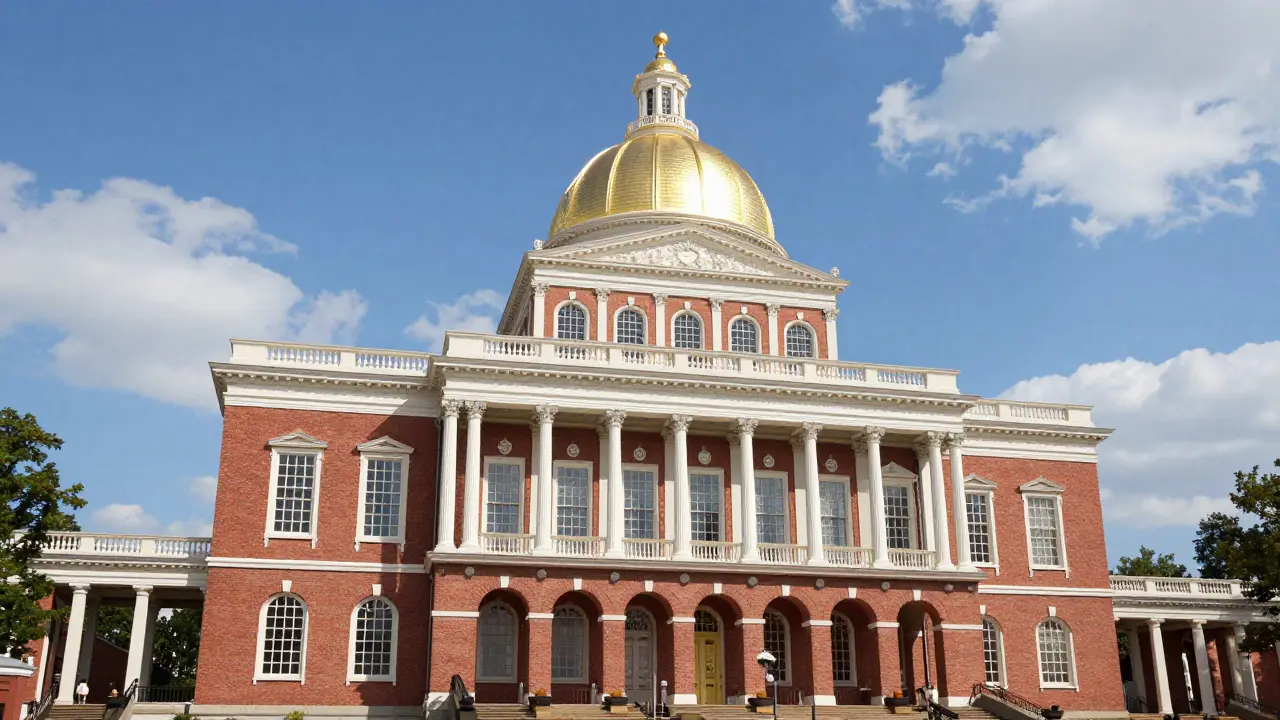
Bulfinch studied in England and brought back books filled with drawings of Roman ruins. He applied these lessons to public buildings, arguing that government structures should look like temples to inspire respect and civic duty. His work on the Massachusetts State House is a prime example. The golden dome? That’s Bulfinch. The clean lines? Also Bulfinch.
Jefferson was different. He was a self-taught architect who read everything he could about Andrea Palladio, an Italian Renaissance architect who revived classical Roman principles. Jefferson’s designs, like Monticello, the plantation home of Thomas Jefferson in Virginia, which serves as a masterpiece of Federal and Palladian architecture featuring a central portico, octagonal rooms, and innovative interior planning, blend European sophistication with practical American needs. He didn’t just copy Rome; he adapted it. He added domes, used local materials, and created spaces that felt open and airy. His influence extended beyond his own home; he set the standard for how universities and state capitols should look across the country.
| Feature | Geographic Style (Pre-1780) | Federal Style (1780-1830) |
|---|---|---|
| Inspiration | British Baroque and Queen Anne | Ancient Roman and Greek temples |
| Ornamentation | Heavy, dark, and bulky | Light, delicate, and refined |
| Windows | Rectangular, multi-pane sash | Elliptical, fanlights, and larger panes |
| Columns | Often painted wood, heavy proportions | Brick or stone, slender, classical orders |
| Roofline | Visible chimneys, steep pitches | Hidden chimneys, low pitch, balustrades |
Iconic Examples Across America
If you want to see Federal architecture in action, you don’t have to travel far. Some of the most famous buildings in the U.S. are perfect examples. Let’s break down three key sites and why they matter.
First, there’s The White House, the official residence of the U.S. President in Washington, D.C., designed by Irish-born architect James Hoban in the Federal style, featuring a symmetrical facade, five-bay arrangement, and a central portico with Ionic columns. Designed by James Hoban, it looks like a modest country estate rather than a palace. That was intentional. The Founding Fathers wanted a president who lived among the people, not above them. The white stucco, the blue shutters, and the balanced wings all scream Federal simplicity.
Second, consider Monticello, Thomas Jefferson's home in Charlottesville, Virginia, which exemplifies the Federal style through its integration of Palladian principles, including a prominent dome, octagonal spaces, and a focus on natural light and ventilation. As mentioned, Jefferson’s home is a hybrid. It has the classical temple front, but also experimental interiors. The way he arranged the rooms to maximize privacy and view shows how the style evolved to meet personal needs, not just aesthetic ones.
Third, look at Massachusetts State House, located on Beacon Hill in Boston, designed by Charles Bulfinch, known for its copper dome, red brick exterior, and green lawn, serving as a model for many subsequent state capitols in the United States. This building changed how Americans viewed government architecture. Before Bulfinch, capitol buildings were often plain and utilitarian. Afterward, they became landmarks. The dome became a symbol of state pride and democratic governance. You can see copies of this idea in cities from Albany to Austin.
Why It Faded and What Replaced It
By the 1830s, Federal architecture was losing its shine. Why? Because tastes change. A new generation of Americans grew up after the Revolution. They didn’t feel the same need to prove their independence through subtle classical references. They wanted something bigger, bolder, and more dramatic. Enter the Greek Revival architecture, a style that emerged in the 1820s and 1830s, characterized by massive columns, triangular pediments, and a direct imitation of ancient Greek temples, replacing the lighter Federal style with heavier, more monumental forms.
Greek Revival took the classical inspiration and turned it up to eleven. Where Federal used slender columns, Greek Revival used thick, sturdy ones. Where Federal had delicate fanlights, Greek Revival had heavy, blocky doorframes. It was less about refinement and more about strength. It fit the expanding, rugged image of the young nation. But even though it faded as a dominant style, Federal architecture never disappeared. It stayed in the background, influencing suburban homes, small town halls, and library buildings well into the 20th century.
Preserving the Past Today
Today, Federal buildings are protected treasures. Organizations like the National Trust for Historic Preservation work to save these structures from demolition or inappropriate renovation. Restoring a Federal building isn’t easy. You have to match original plasterwork, replicate intricate wood carvings, and sometimes rebuild entire facades using period-correct techniques. But it’s worth it. These buildings connect us to the minds that built our country. They remind us that democracy wasn’t just written in documents; it was built in stone.
If you live in an older part of a city, take a closer look at the houses around you. Check the doorways. Look at the windows. You might be walking through a piece of living history. Federal architecture is quiet, understated, and deeply American. It doesn’t shout for attention; it earns it through balance, beauty, and meaning.
What is the main difference between Federal and Georgian architecture?
The main difference lies in the level of ornamentation and inspiration. Georgian architecture is heavier, darker, and influenced by British Baroque styles. Federal architecture is lighter, more delicate, and directly inspired by ancient Roman and Greek temples. Federal buildings feature fanlights, elliptical windows, and slender columns, whereas Georgian buildings have simpler rectangular windows and bulkier moldings.
Who are the most famous architects of the Federal style?
Two key figures are Charles Bulfinch and Thomas Jefferson. Bulfinch introduced neoclassical elements to public buildings like the Massachusetts State House and the U.S. Capitol. Jefferson applied classical principles to private and academic buildings, most notably Monticello and the University of Virginia, blending European elegance with American practicality.
When did Federal architecture become popular in the United States?
Federal architecture rose to prominence around 1780, shortly after the American Revolution, and remained the dominant style until about 1830. It was replaced by the heavier, more monumental Greek Revival style as national tastes shifted toward a stronger, more assertive visual identity.
Can I find Federal architecture outside of major cities?
Yes, absolutely. While grand examples exist in Washington, D.C., and Boston, many smaller towns across the Northeast and Mid-Atlantic regions feature Federal-style homes, courthouses, and churches. Look for symmetrical facades, fanlights above doors, and low-pitched roofs in historic districts.
Why did the Founding Fathers choose classical styles for government buildings?
They chose classical styles to associate the new American republic with the democratic ideals of ancient Greece and the legal traditions of Rome. By avoiding British Gothic or Baroque styles, they visually rejected monarchy and emphasized values like reason, order, and civic virtue.