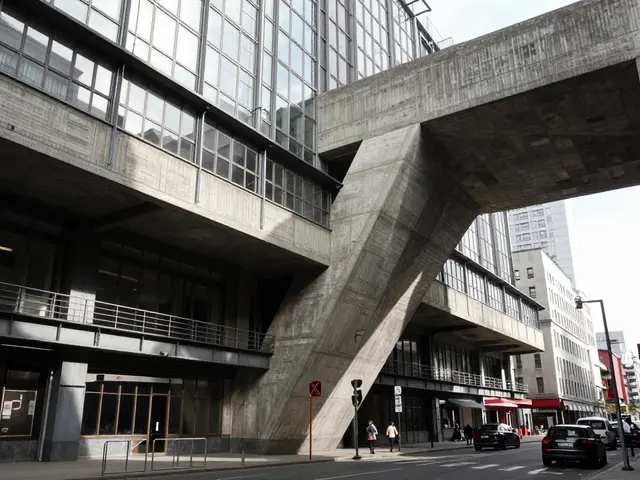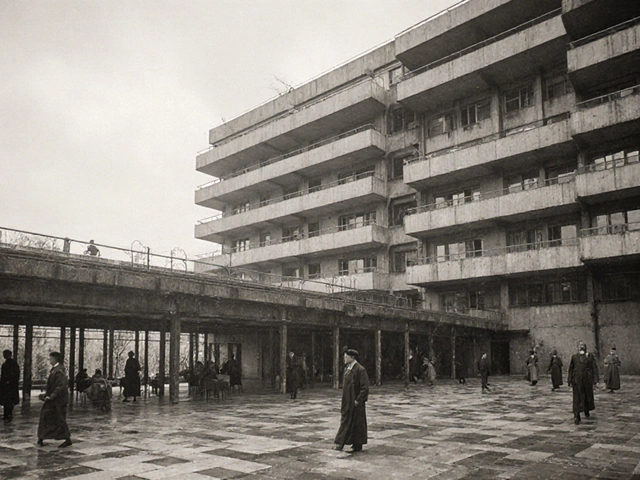
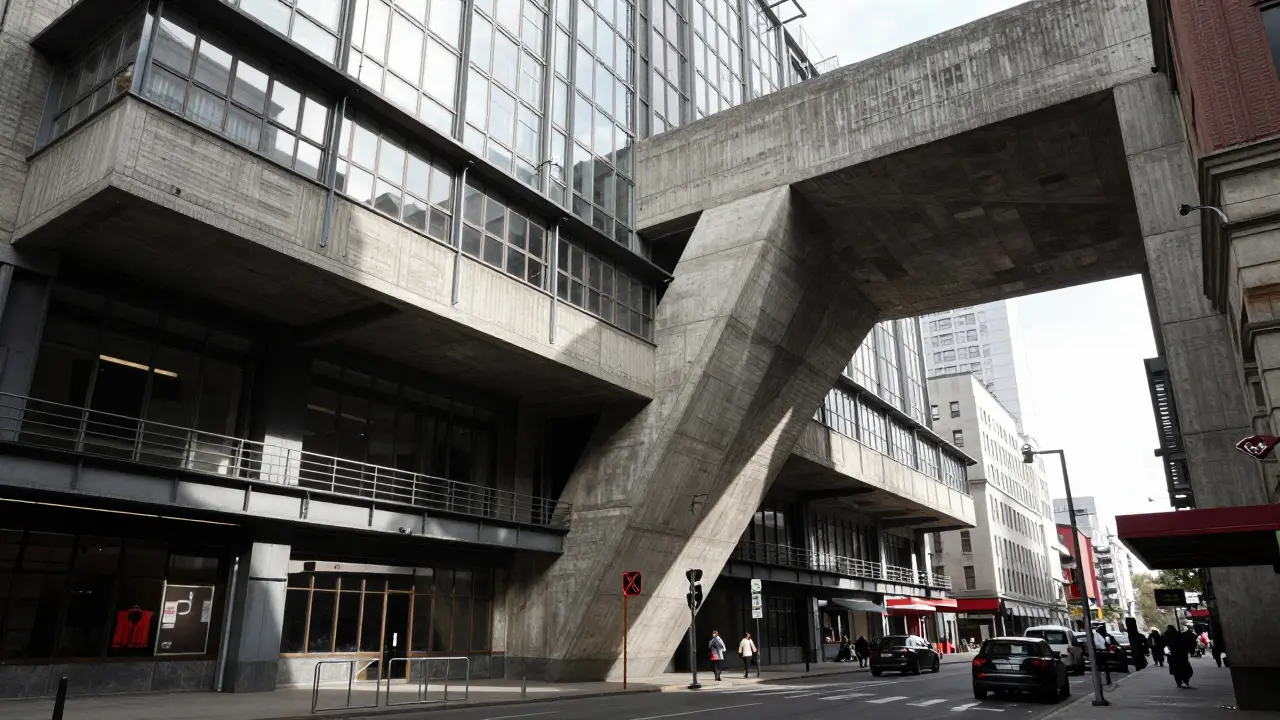
When we talk about constructivist architecture, we aren't discussing a set of rules for a fancy facade. We are talking about a radical social experiment born from the chaos of the Russian Revolution. The goal was to create an environment that forced people to interact, collaborate, and think differently about their roles in society. It's the architectural equivalent of a loud wake-up call.
Quick Takeaways: The Core of Constructivism
- Function over form: Every beam, window, and stair is there for a reason, not for decoration.
- Industrial materials: Heavy use of glass, steel, and reinforced concrete to mirror the machine age.
- Social Condensers: Buildings designed to "compress" social classes and force diverse groups to mingle.
- Dynamic Geometry: Use of intersecting planes, diagonals, and floating volumes to create a sense of movement.
The Blueprint of a Social Revolution
At its heart, Constructivism is an artistic and architectural philosophy that emerged in Russia around 1913, treating the artist as a "constructor" who assembles industrial materials to serve a social purpose. Unlike the traditional styles that looked back at Greece or Rome, these architects looked forward to the factory. They believed that the way we build our rooms determines how we think. If you put a communal kitchen in a housing block, you don't just save space-you kill the isolation of the nuclear family and replace it with collective solidarity.
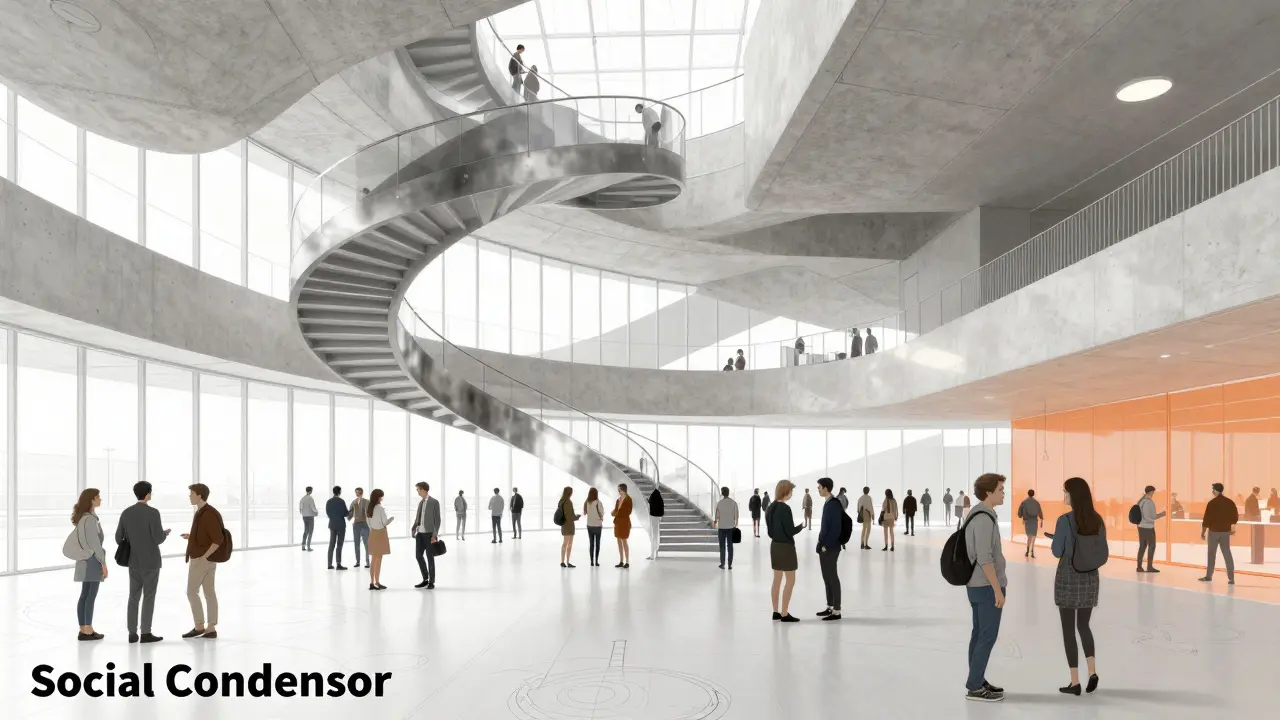
This movement didn't happen in a vacuum. It was driven by the Soviet Avant-Garde, a group of artists and thinkers who wanted to strip art of its "spiritual" baggage. They viewed the building as a tool. If a staircase looked like a spiral of steel cutting through a glass wall, it wasn't because it looked "cool," but because it visualized the flow of people moving through a space. The geometry was meant to be active, not passive.
The Concept of the Social Condenser
One of the most fascinating parts of this era is the idea of the Social Condenser, a building designed to catalyze social change by forcing different social groups into shared spaces. Think of it as a physical nudge. Instead of having a private living room, a constructivist building might have a massive communal lounge and a shared laundry. The theory was that by removing private boundaries, the state could "condense" the old habits of the bourgeoisie into the new habits of the proletariat.
Take the Narkomfin building in Moscow as a real-world example. It wasn't just an apartment complex; it was a machine for living. It featured individual cells for sleeping but moved all the "heavy lifting" of life-cooking, eating, and childcare-into shared blocks. This layout was a deliberate attempt to free women from domestic drudgery and integrate them into the workforce, proving that a floor plan could be a political statement.
Materials and the Machine Aesthetic
To achieve this vision, architects turned to the materials of the industrial revolution. They stopped using plaster and ornate carvings and started using Reinforced Concrete, glass, and steel. These materials allowed for daring feats of engineering, like cantilevered balconies and massive glass curtains that let light flood into previously dark interiors.
| Attribute | Traditional Architecture | Constructivist Architecture |
|---|---|---|
| Primary Goal | Aesthetic beauty / Status | Social utility / Efficiency |
| Key Materials | Stone, Wood, Brick | Steel, Glass, Concrete |
| Ornamentation | High (Columns, Friezes) | None (Exposed Structure) |
| Spatial Logic | Symmetrical / Closed | Asymmetrical / Open Flow |
The Influence of Vkhutemas
You can't talk about this movement without mentioning Vkhutemas, the State Higher Art and Technical Studios in Moscow, often called the "Soviet Bauhaus". This was the pressure cooker where these ideas were refined. Students didn't just draw buildings; they studied the psychology of movement and the physics of materials.
Vkhutemas taught that the architect is an engineer of human life. They pushed for an integrated approach where furniture, graphics, and architecture all followed the same logic of efficiency. This is why a constructivist chair looks as skeletal and purposeful as a constructivist factory. They wanted a total environment where nothing was wasted and every object had a job to do.

From Utopia to Reality: The Struggle of Implementation
Here is the catch: many of the most iconic constructivist designs were never actually built. They existed as "paper architecture"-stunning drawings and models that were too advanced for the technology or the budget of the 1920s. Tatlin's Tower is the perfect example. It was designed as a massive, spiraling iron tower that would dwarf the Eiffel Tower and rotate on its axis. It was a masterpiece of vision, but it was physically impossible to build with the resources they had at the time.
Even the buildings that were completed faced a harsh reality. The "social condensers" often failed because people actually liked their privacy. The idea that a shared kitchen would automatically make you a better comrade didn't always pan out. However, the influence of these designs leaked into the rest of the world, paving the way for Modernism and the International Style, where the "less is more" mantra became the gold standard for city skyscrapers across the globe.
How Constructivism Still Shapes Our Cities
You might not see many red-and-white Soviet posters today, but the ghost of constructivism is everywhere. Every time you walk into a modern open-plan office or a minimalist apartment with floor-to-ceiling glass, you are experiencing the legacy of the 1920s avant-garde. The move toward modular housing and prefabricated buildings-designed to be cheap, fast, and functional-stems directly from the constructivist desire to solve the housing crisis through industrialization.
Even the way we think about "user experience" (UX) in design has roots here. The constructivists were some of the first to analyze how a person actually moves through a building, treating the human as a component in a larger system. They shifted the focus from how a building looks to how it works, a perspective that defines almost everything we build today.
What is the main difference between Constructivism and Modernism?
While both value function and industrial materials, Constructivism was explicitly political and social. It aimed to use architecture to engineer a new socialist society. Modernism, while sharing the aesthetic of clean lines and efficiency, often focused more on the universal laws of design and luxury or corporate utility rather than a specific ideological social restructuring.
Who were the key figures in Constructivist architecture?
Vladimir Tatlin is perhaps the most famous for his conceptual towers. Moisei Ginzburg is crucial for his work on the Narkomfin building and the theory of the social condenser. El Lissitzky bridged the gap between abstract art and architecture, creating "Prouns" that influenced how we perceive 3D space in design.
Why did the movement eventually fade away?
The movement fell victim to a change in political taste. By the 1930s, Joseph Stalin moved away from the experimental avant-garde and toward "Socialist Realism." This new style demanded monumental, classical buildings that looked like palaces to project power and stability, making the stripped-back, industrial look of constructivism seem too modest or "too Western."
Are there any surviving examples of Constructivist buildings?
Yes, though many have deteriorated. The Narkomfin building in Moscow has undergone restoration. You can also find many examples of worker's clubs and communal housing in various post-Soviet cities, as well as the influence in the works of Le Corbusier, who was deeply impressed by the Soviet approach to urban planning.
Can Constructivist principles be applied to modern sustainable design?
Absolutely. The focus on efficiency, the removal of wasteful ornamentation, and the use of prefabricated materials align perfectly with current sustainable goals. The idea of shared resources (like co-living spaces) is a modern version of the social condenser, aimed at reducing the carbon footprint of individual households.
Next Steps for the Design Enthusiast
If you're fascinated by the idea of architecture as a social tool, start by looking into the Bauhaus movement in Germany. It shared a lot of DNA with Vkhutemas and will give you a broader view of how the machine age changed art. You might also want to explore the concept of "Brutalism" from the 1950s, which took the raw, concrete honesty of constructivism and pushed it to a massive, imposing scale.