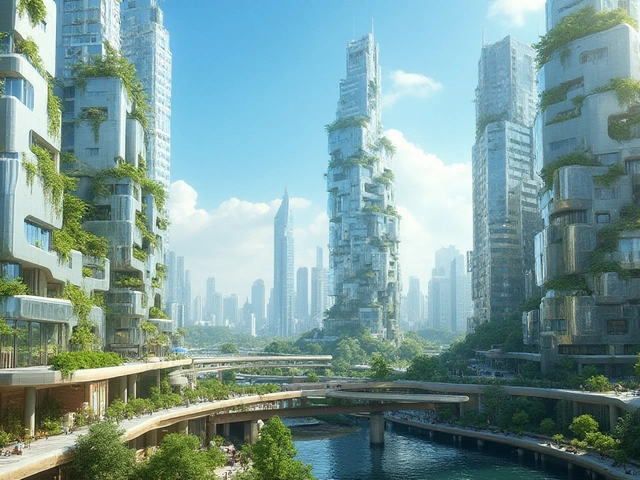
Walk into the lobby of a modern tech headquarters or glance up at a glass-and-steel skyscraper in London or New York, and you are looking at the legacy of a radical architectural movement. High-tech architecture is a style that exposes building services like ducts, pipes, and structural steel as aesthetic features rather than hiding them behind walls. It turned buildings into machines for living, celebrating industrial engineering with the same reverence we usually reserve for fine art.
This wasn't just about making things look cool. It was a philosophical shift. Architects stopped pretending that a building’s guts were ugly. Instead, they argued that honesty in construction-showing how a building actually stands up and breathes-was the most beautiful thing possible. Today, this style has evolved from the bold experiments of the 1970s into the smart, sustainable towers of the 2020s.
The Birth of Structural Honesty
To understand where high-tech architecture came from, you have to look back at the late 1960s and early 1970s. At that time, most architects were obsessed with minimalism or brutalist concrete blocks. But a group of young designers, including Richard Rogers, Norman Foster, and Cecil Balmond, looked at industrial structures like oil rigs and factories and saw beauty in their logic.
They asked a simple question: Why do we hide the skeleton of a building? In traditional design, load-bearing columns and ventilation shafts were wrapped in drywall and plaster. High-tech architects decided to flip this script. They wanted to create flexible spaces where the structure itself defined the interior. This approach is often called Structural Expressionism, because it expresses the function of the parts through their form.
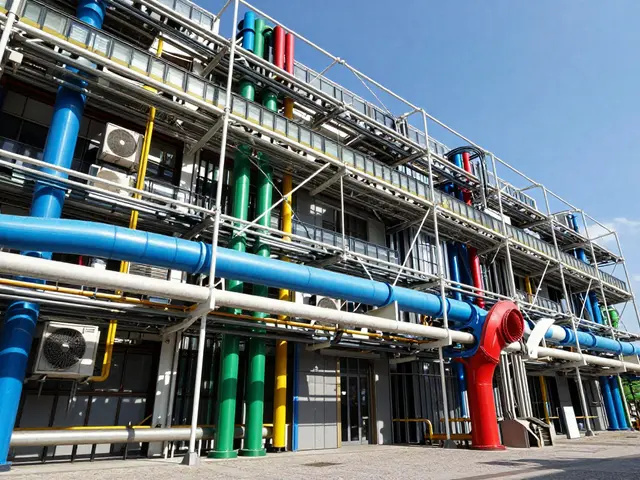
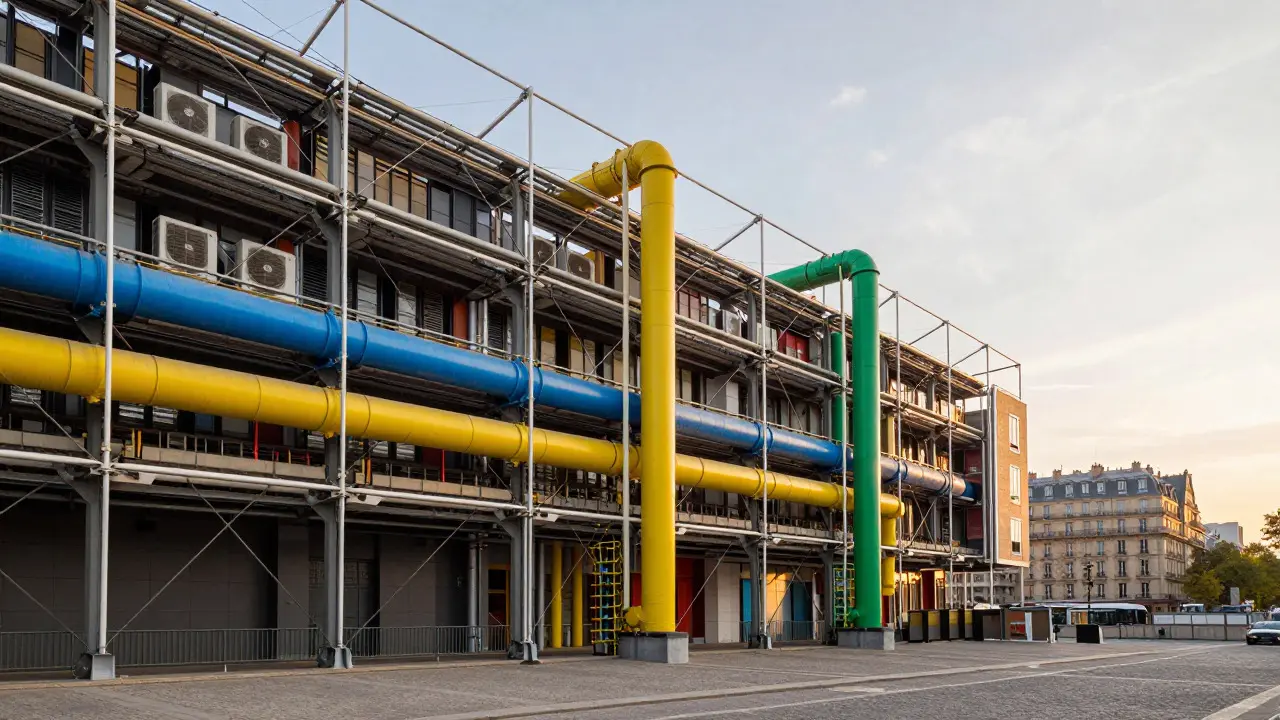
The inspiration didn't come from other buildings. It came from engineering manuals and aviation. The use of primary colors to identify different service systems-blue for air conditioning, yellow for electricity, green for water-was borrowed from industrial safety standards. This made the buildings not only visually striking but also incredibly practical for maintenance. If a pipe leaks, you can see exactly which one it is from the outside.
The Iconic Era: Pompidou and Lloyd's
No discussion of high-tech architecture is complete without mentioning the Centre Pompidou in Paris, designed by Richard Rogers and Renzo Piano and completed in 1977. When it opened, people protested. They hated it. It looked like an inside-out factory with giant colored tubes running along its facade. But it changed everything. It proved that a cultural institution could be dynamic, transparent, and deeply connected to the city street.
Then came the Lloyd's Building in London, also by Rogers, finished in 1986. While the Pompidou put services on the exterior to keep the interior open, the Lloyd's Building did the opposite. It kept the core clean and elegant while pushing all the messy utilities-elevators, stairs, toilets-to the outside. This allowed the floor plates to be completely free of columns, giving tenants maximum flexibility to reconfigure their offices. This concept of "serviced floors" became a blueprint for modern commercial real estate.
| Building | Location | Key Architect(s) | Design Philosophy |
|---|---|---|---|
| Centre Pompidou | Paris, France | Rogers & Piano | Exterior services; colorful industrial aesthetic |
| Lloyd's Building | London, UK | Richard Rogers | Interior flexibility; external core services |
| HSBC Headquarters | Hong Kong | Norman Foster | Natural ventilation; courtyard integration |
The American Interpretation: Steel and Glass
While British architects focused on color and exposed mechanics, American firms took a different path. In the United States, high-tech architecture merged with corporate power and financial prestige. The result was sleeker, quieter, and more expensive.
Firms like Skidmore, Owings & Merrill (SOM) and Pei Cobb Freed & Partners developed what some call "American High-Tech." Think of the John Hancock Center in Chicago or the Citigroup Center in New York. These buildings still celebrated structure-the X-bracing on the Hancock is a classic example-but they hid the mechanical systems behind polished metal and glass skins.
The focus here was on efficiency and height. Engineers worked closely with architects to push the limits of steel and concrete. The goal wasn't just to show off pipes; it was to create the tallest, most efficient office towers possible. This era established the image of the modern skyline: reflective glass, slender profiles, and visible structural rhythms.
From Industrial Aesthetics to Digital Precision
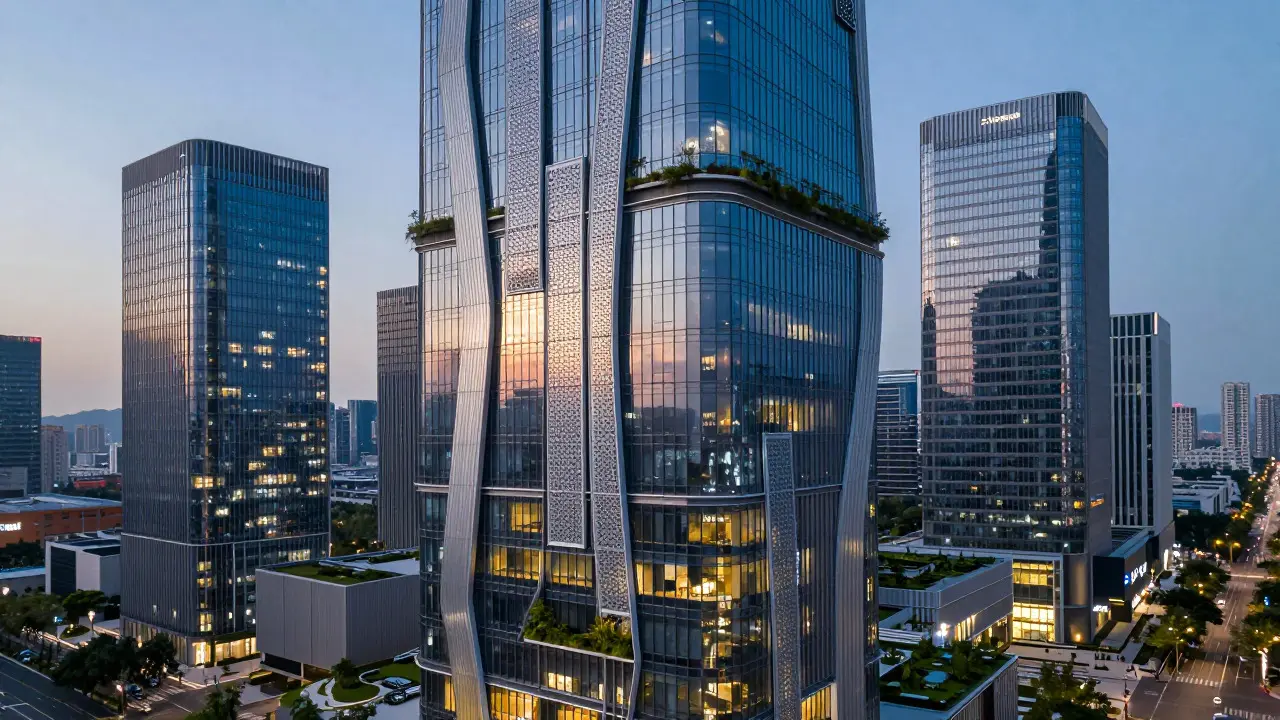
As we moved into the 1990s and 2000s, technology changed again. Computers became powerful enough to handle complex calculations that were impossible before. This led to the rise of parametric design and computational modeling. Architects like Zaha Hadid and Frank Gehry began using software to create fluid, organic shapes that defied traditional geometry.
High-tech architecture didn't disappear; it evolved. The rigid grids of the 1970s gave way to curved facades and adaptive structures. The Guggenheim Museum Bilbao is a prime example. Its titanium skin isn't just decorative; it's engineered to reflect light and change appearance depending on the weather. This marked a shift from "machine aesthetics" to "digital craftsmanship."
At the same time, materials science advanced. We started seeing carbon fiber, laminated timber, and self-healing concrete used in major projects. The emphasis shifted from exposing steel beams to integrating smart materials that respond to their environment. Buildings became less static objects and more active participants in their surroundings.
Sustainability Meets Technology
Today, the biggest driver of high-tech architecture is sustainability. Climate change has forced architects to rethink every aspect of building design. Energy consumption, carbon footprint, and resource efficiency are now top priorities. This has led to a new wave of "green high-tech" buildings.
Modern high-tech designs prioritize passive strategies first. Large overhangs block summer sun while letting winter light in. Natural ventilation stacks draw hot air out without using fans. Green roofs and vertical gardens reduce heat island effects and improve air quality. The Bosco Verticale in Milan, designed by Stefano Boeri, is a famous example. Two residential towers covered in thousands of trees and shrubs act as natural filters for urban pollution.
But technology still plays a huge role. Smart sensors monitor temperature, humidity, and occupancy in real-time, adjusting lighting and HVAC systems automatically. Photovoltaic glass generates electricity while providing shade. Rainwater harvesting systems feed irrigation and toilet flushing. These technologies aren't hidden away; they are integrated into the design narrative, showing visitors how the building works sustainably.

The Future: Adaptive and Responsive Structures
Where is high-tech architecture heading next? The answer lies in adaptability. As climate patterns become more unpredictable and work habits continue to shift, buildings need to be flexible. Imagine facades that open and close like gills based on wind direction. Or interiors that reconfigure themselves using motorized partitions controlled by AI.
We are already seeing prototypes of kinetic architecture. The Al Bahar Towers in Abu Dhabi feature a dynamic shading system inspired by traditional Islamic mashrabiya screens. The panels move throughout the day to block direct sunlight, reducing cooling loads by up to 50%. This isn't just gimmickry; it's essential performance optimization.
Another trend is the integration of renewable energy generation directly into the building envelope. Solar windows, piezoelectric floors that generate power from footsteps, and wind turbines embedded in spires are becoming more common. The boundary between infrastructure and architecture is blurring. Buildings are no longer just consumers of energy; they are producers.
Why This History Matters Now
Understanding the evolution of high-tech architecture helps us appreciate the complexity of our built environment. It reminds us that buildings are not just boxes for people; they are sophisticated machines that interact with nature, technology, and society. The principles established in the 1970s-honesty, flexibility, and innovation-are more relevant than ever.
As we face global challenges like urbanization and climate change, the lessons from this historical perspective guide us forward. We need buildings that are transparent in their operations, adaptable to changing needs, and respectful of ecological limits. High-tech architecture provides the toolkit to achieve these goals. By looking back at how far we've come, we can better envision where we're going.
What defines high-tech architecture?
High-tech architecture is defined by the exposure of structural elements and building services such as ducts, pipes, and elevators as part of the aesthetic design. It emphasizes industrial materials like steel and glass, celebrates engineering logic, and prioritizes functional flexibility over traditional ornamentation.
Who are the key figures in high-tech architecture?
Key figures include Richard Rogers, Norman Foster, Cecil Balmond, Renzo Piano, and Michael Hopkins. These architects pioneered the style in the 1970s and 1980s with iconic projects like the Centre Pompidou and Lloyd's Building, establishing the principles of structural expressionism.
How has high-tech architecture evolved since the 1970s?
Since the 1970s, high-tech architecture has shifted from purely industrial aesthetics to incorporating digital design tools, sustainable technologies, and smart materials. Modern examples focus on energy efficiency, adaptive facades, and environmental responsiveness, moving beyond mere structural exposure to holistic performance.
Is high-tech architecture sustainable?
Yes, contemporary high-tech architecture heavily emphasizes sustainability. Through the use of natural ventilation, solar integration, rainwater harvesting, and smart energy management systems, modern high-tech buildings aim to minimize environmental impact while maintaining high performance and comfort.
What is the difference between British and American high-tech architecture?
British high-tech architecture, exemplified by Rogers and Foster, often features colorful, exposed services and a playful, industrial aesthetic. American high-tech, seen in works by SOM and Pei Cobb Freed, tends to be more subdued, focusing on sleek glass facades, structural elegance, and corporate prestige rather than explicit mechanical display.