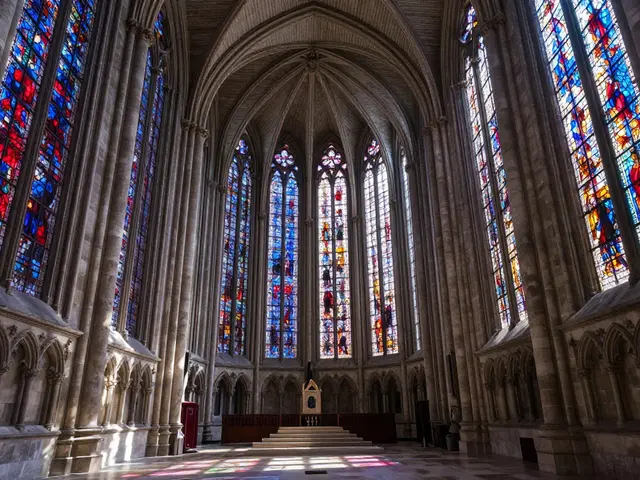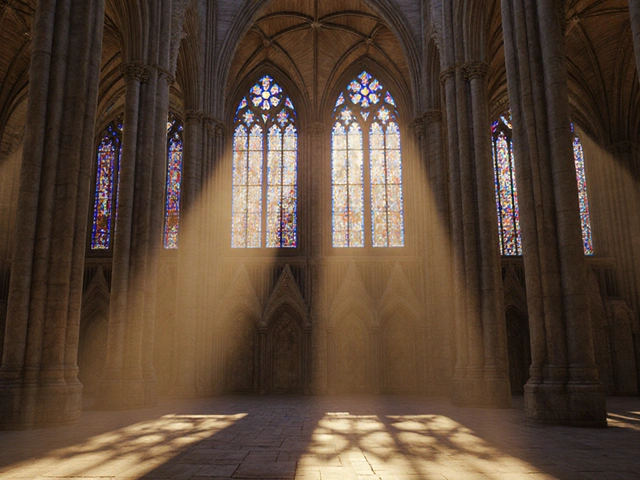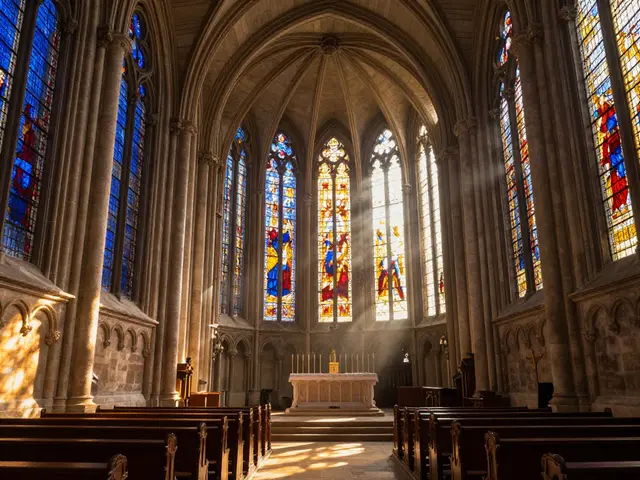
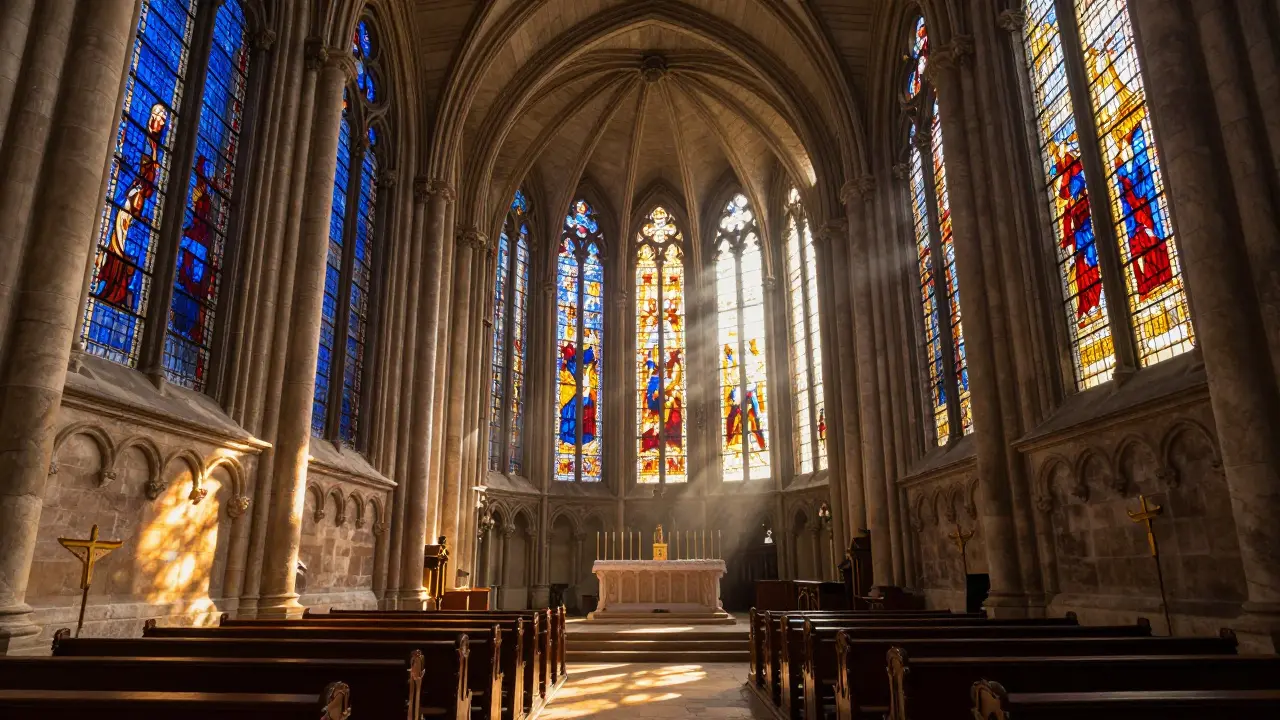
When you walk into a gothic cathedral, something feels different. The air is cooler. The light shifts in strange ways. Your eyes are pulled upward, not by force, but by pure pull - like gravity reversed. These buildings weren’t just made to shelter people. They were built to make you feel small, not in a bad way, but in a way that made you believe something bigger was watching.
The Rise of the Impossible
Gothic architecture didn’t start as a style. It started as a problem. In the 12th century, churches in northern France were getting bigger. More people wanted to worship. More gold and relics meant more need for space. But stone walls couldn’t get taller without collapsing. The thick walls needed to hold up heavy roofs blocked out light. Churches were dark, heavy, and cramped.
Then came the breakthrough: the pointed arch. Unlike the rounded Romanesque arch, which pushed outward with brute force, the pointed arch directed weight straight down. That small change meant walls didn’t need to be as thick. More space for windows. More light. Suddenly, walls became canvases for stained glass - deep reds, royal blues, and golds that turned sunlight into divine fire.
But the real magic? The flying buttress. Imagine stone arms reaching out from the church’s sides, arching over the aisles, and locking into heavy stone piers. These weren’t decorations. They were structural lifelines. They took the outward push from the high vaulted ceilings and transferred it away from the walls, letting them become thin, glass-filled screens. It was like building a skeleton outside the building so the inside could breathe.
At Chartres Cathedral, built between 1194 and 1220, over 150 square meters of stained glass survive - more than any other medieval church. The windows aren’t just pictures. They’re theological textbooks. A single window tells the story of Christ’s life, the lives of saints, and the duties of kings - all in colored light. People who couldn’t read could still understand the Bible. That’s the power of gothic design.
Engineering the Sky
People called gothic buildings ‘the art of the impossible’ because they defied logic. How could a stone tower reach 100 meters without falling? How could walls hold up a roof while being mostly glass? The answer lies in three things: geometry, materials, and patience.
Builders used precise geometry. Every arch, every rib, every vault followed mathematical rules passed down from master masons. They didn’t have calculators. They used compasses, ropes, and carved wooden templates. The ribbed vault - a network of stone ribs forming a skeleton over the ceiling - distributed weight evenly. This allowed ceilings to rise higher and span wider than ever before.
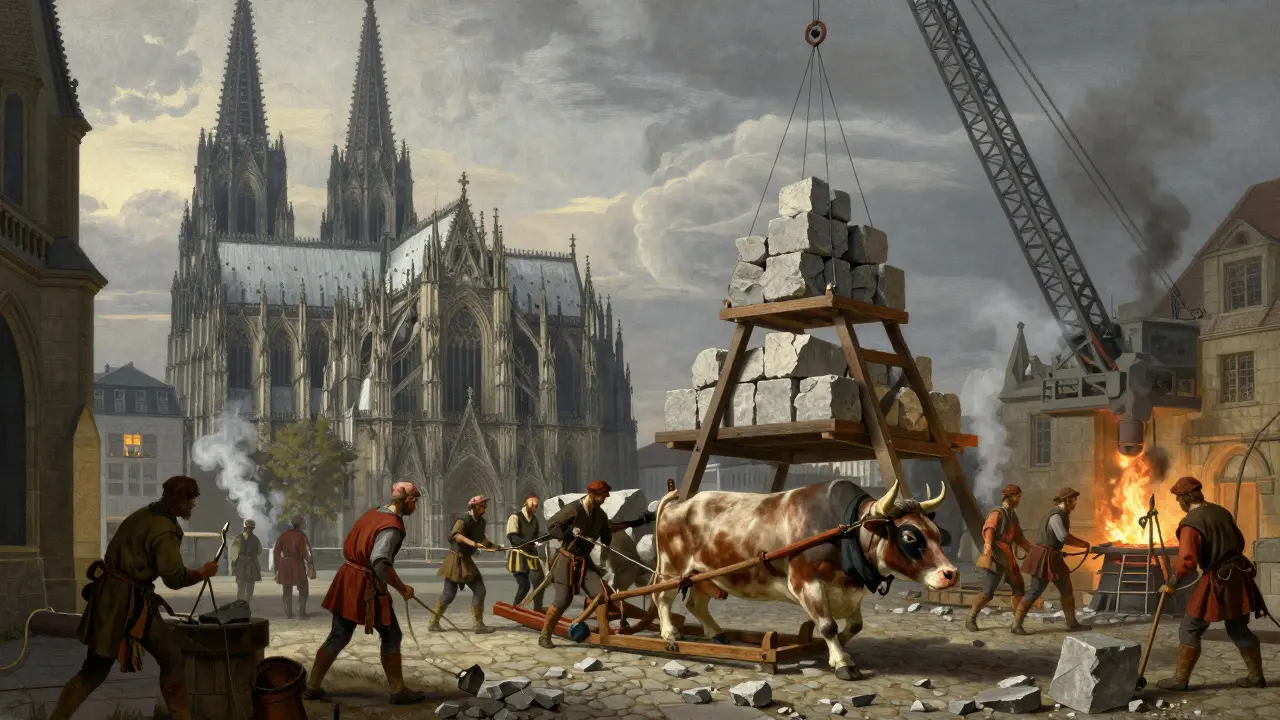
Materials mattered too. Limestone was the favorite. It was light enough to lift with pulleys, strong enough to last centuries, and easy to carve. At Notre-Dame de Paris, the stone came from quarries just outside the city. Workers shaped each block by hand. Some blocks weighed over a ton. They were moved on wooden sleds, pulled by teams of oxen, then hoisted into place with cranes powered by human treadmills.
And time? These cathedrals took generations. Construction of Cologne Cathedral began in 1248 and wasn’t finished until 1880 - over 600 years later. A master mason might spend his whole life working on just one section. His son might continue. His grandson might see the spire completed. This wasn’t a project. It was a legacy.

The Details That Made the Difference
Gothic isn’t just about height and light. It’s in the details you almost miss.
Gargoyles aren’t just scary faces. They’re functional drains. Rainwater runs through their mouths, flung far from the walls to prevent erosion. Chimera - mythical beasts like griffins and dragons - weren’t just decoration. They warned of evil spirits lurking beyond the church’s sacred walls.
The rose windows? They’re not just beautiful. They’re engineered. At Amiens Cathedral, the north rose window is 13 meters wide. Its stone tracery holds the glass in place like a spiderweb. Each piece of glass is hand-blown, colored with metallic oxides, and painted with details using enamel. The whole thing weighs over 10 tons. It’s held by iron bars hidden in the stone frame - an invisible support system.
Even the doorways told stories. The west façade of Reims Cathedral has 2,300 statues. Each one is unique - kings, bishops, angels, peasants. They weren’t just art. They were a social map of medieval Europe. The tallest statue? The Virgin Mary, standing above the central portal, her arms open - welcoming, not commanding.
Why It Still Matters
Modern architects still study gothic buildings. Not because they want to copy them, but because they solved problems we still struggle with.
Today’s skyscrapers use steel frames to reach great heights. Gothic builders did it with stone and geometry. They didn’t need concrete or electricity. They used physics, not technology. Their buildings lasted 700 years without major structural repairs. Many still stand today, untouched by modern renovations.
Look at the Burj Khalifa or the Shard in London. They’re tall, but they’re hollow shells. Gothic cathedrals were solid, dense, and alive with meaning. Every stone had a purpose. Every window told a story. Every beam carried the weight of belief.
When the fire hit Notre-Dame in 2019, the world held its breath. Not because it was a tourist spot. But because it was proof that humans once believed they could reach the heavens - not with rockets, but with stone, light, and patience.
Where to See the Best Examples
If you want to feel what gothic architecture really is, go to the source.
- Chartres Cathedral (France) - The most complete example of High Gothic. Its stained glass is unmatched.
- Notre-Dame de Paris (France) - The prototype. The one that started it all. Still standing, still healing.
- Cologne Cathedral (Germany) - The tallest twin-spired cathedral in the world. Took 600 years. Worth every second.
- Canterbury Cathedral (England) - The heart of English Gothic. Pilgrims walked here for centuries.
- Milan Cathedral (Italy) - A gothic fever dream. Over 3,000 statues. Marble that glows in sunlight.
Even in places like Melbourne, you can find gothic echoes. The University of Melbourne’s Old Quad, built in the 1850s, uses pointed arches and flying buttresses. It’s not medieval, but it’s inspired. It’s a reminder that the past still shapes how we build today.
What Made Gothic Different
Other styles - Romanesque, Baroque, Neoclassical - were about power. Gothic was about wonder.
Romanesque churches were thick-walled, dark, and grounded. Baroque churches were loud, gilded, and theatrical. Gothic? It was quiet. It was vertical. It made you look up and feel something you couldn’t name.
It wasn’t just about religion. It was about ambition. A town could spend 50 years building a cathedral because they believed in something bigger than themselves. Money came from merchants, peasants, nobles. Everyone gave. Even the poorest left coins in the collection box. The cathedral became their shared soul.
That’s why gothic architecture still moves us. We don’t build like that anymore. We build fast. We build cheap. We build for efficiency, not eternity.
But when you stand under a gothic vault, you don’t think about cost. You think about courage. About people who believed they could touch the sky - and did.
What makes gothic architecture different from other styles?
Gothic architecture stands out because of its focus on height, light, and structural innovation. Unlike Romanesque buildings with thick walls and small windows, gothic structures used pointed arches, ribbed vaults, and flying buttresses to create taller, lighter spaces filled with stained glass. This wasn’t just aesthetic - it was engineering that allowed walls to become glass screens, turning cathedrals into luminous sacred spaces.
Why were flying buttresses so important?
Flying buttresses were the secret weapon of gothic builders. They transferred the outward thrust from high stone vaults away from the walls and down into massive external piers. This allowed walls to be thinner and filled with large stained-glass windows. Without them, cathedrals like Chartres or Notre-Dame couldn’t have reached their incredible heights. They turned structural weakness into visual strength.
How did gothic architects build without modern tools?
They relied on geometry, experience, and handcrafted tools. Master masons used compasses, wooden templates, and ropes to lay out designs. Stone was carved on-site or in nearby quarries. Cranes powered by human treadmills lifted heavy blocks. Each piece was numbered and fitted like a puzzle. No blueprints existed in the modern sense - knowledge was passed down orally and through scale models.
Are there gothic buildings outside Europe?
Yes. Gothic style spread through colonization and religious missions. In the Americas, you’ll find gothic revival churches in the U.S., Canada, and Latin America. In Australia, buildings like the University of Melbourne’s Old Quad and St. Patrick’s Cathedral in Melbourne use gothic elements. These aren’t medieval originals, but 19th-century revivals that borrowed the form to express spiritual grandeur.
Why did gothic architecture fall out of favor?
By the 16th century, the Renaissance brought a shift toward symmetry, proportion, and classical forms. Gothic was seen as chaotic and ‘barbaric’ - a term that originally meant ‘non-Roman.’ The Reformation also reduced church funding in many regions. It wasn’t that gothic was bad - it was out of fashion. But in the 1800s, it made a comeback during the Gothic Revival, especially in churches and universities.