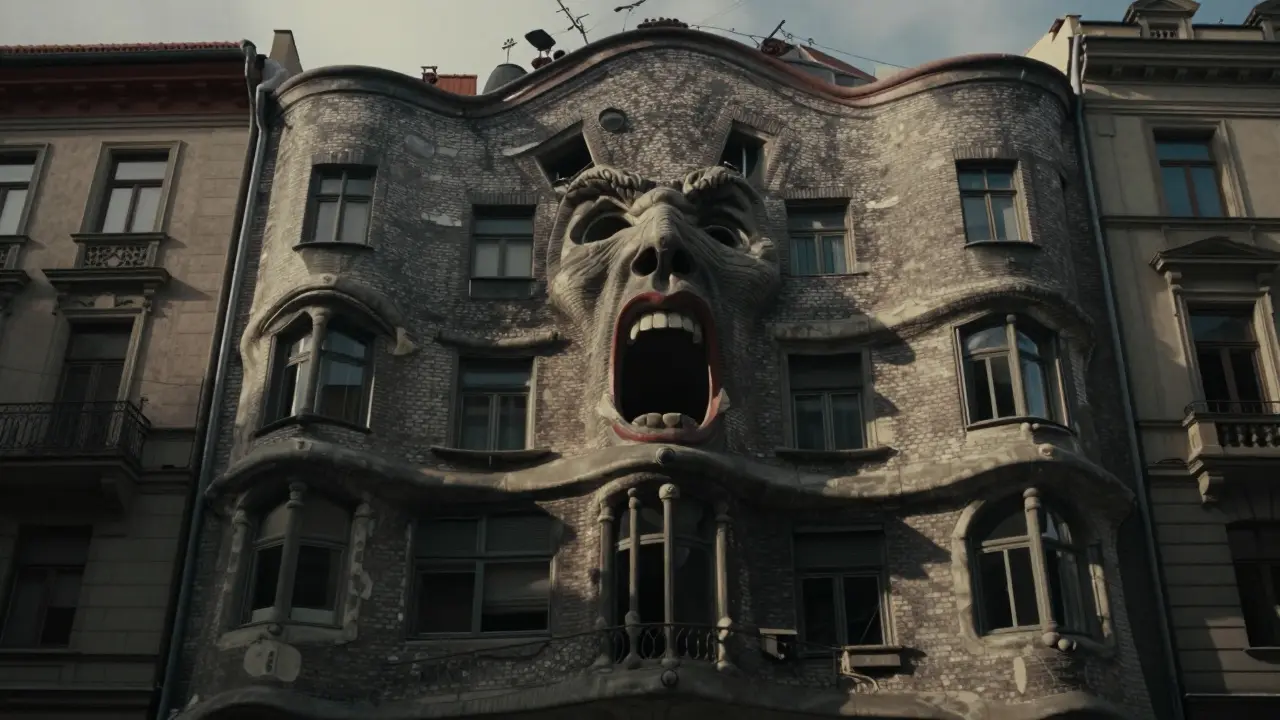
Imagine walking past a building that looks less like a structure and more like a frozen scream. The walls twist upward, the windows seem to bulge with tension, and the entire facade feels alive with raw emotion. This isn’t science fiction or a dystopian movie set-it’s Expressionist Architecture, an early 20th-century style that prioritized emotional experience over functional logic. While styles like Minimalism or Brutalism have their own distinct voices, Expressionism shouts from the rooftops. It challenges the idea that buildings must be purely rational boxes for human activity.
You might wonder why this matters today. In an era dominated by sleek glass towers and standardized concrete slabs, understanding Expressionism helps us appreciate the radical idea that architecture can tell a story, evoke fear, inspire awe, or simply feel *human*. It was a brief but explosive period, mostly concentrated between 1910 and 1930, primarily in Germany and Austria. Today, its legacy lives on in everything from theme park rides to contemporary museum designs.
The Core Philosophy: Emotion Over Function
To understand Expressionist Architecture, you first need to drop the rulebook of classical proportions. Traditional architecture relied on symmetry, balance, and historical references (like Greek columns or Roman arches). Expressionists rejected all of that. They believed that the external form of a building should reflect the internal state of the architect-or even the collective anxiety of the society at the time.
This wasn’t just about making things look "weird." It was a deliberate attempt to visualize the subconscious. Think of it as visual poetry. If Cubism broke down objects into geometric shapes on canvas, Expressionist Architecture broke down the very concept of stability in three-dimensional space. Walls didn’t just hold up roofs; they leaned, twisted, and flowed. Roofs weren’t just protective covers; they soared like wings or hunched like beasts.
The movement emerged during a time of massive social upheaval. World War I had shattered European confidence. Industrialization was alienating people from nature. Architects responded by creating structures that felt organic, spiritual, and deeply personal. They wanted to reconnect humans with their primal emotions, using brick, steel, and glass not as cold materials, but as mediums for expression.
Key Characteristics That Define the Style
If you’re trying to spot an Expressionist building, look for these specific traits. Unlike Art Deco, which is decorative and symmetrical, or Modernism, which is clean and grid-based, Expressionism is chaotic and fluid.
- Dynamic Forms: Buildings rarely have right angles. You’ll see curved walls, sloping floors, and asymmetrical facades that suggest movement.
- Material Experimentation: Brick was often used in unconventional ways-twisted, patterned, or left rough to emphasize texture. Steel and glass were combined to create light, ethereal effects rather than rigid frames.
- Dramatic Lighting: Windows are often irregularly shaped or placed to cast strange shadows. Light becomes a sculpting tool, highlighting the drama of the form.
- Spiritual Symbolism: Many designs reference religious or mythological themes, aiming to elevate the viewer’s spirit through sheer scale and shape.
- Rejection of Ornament: Unlike Baroque or Rococo, Expressionism doesn’t add decoration on top of a plain surface. The decoration *is* the structure itself. The curve of the wall is the ornament.
Consider the way a tree grows. It doesn’t follow a blueprint. It twists toward the sun, branches out unevenly, and reacts to wind. Expressionist architects tried to mimic this natural, uncontrolled growth in their designs. They wanted buildings to feel grown, not built.
Pioneers and Their Masterpieces
No architectural movement happens in a vacuum. Several key figures drove Expressionism forward, each bringing a unique vision to the table. Let’s look at who they were and what they created.
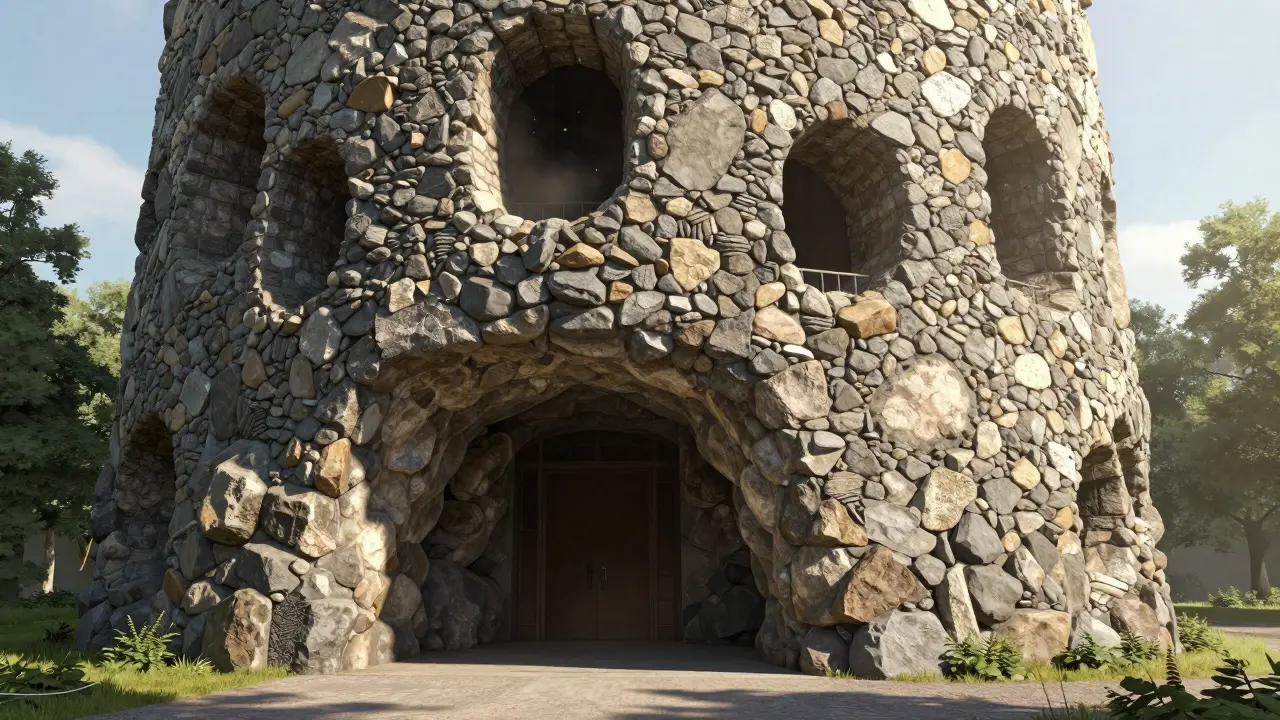
Ernst Neufert designed the Einstein Tower in Potsdam, Germany, completed in 1921. At first glance, it looks like a pile of rocks fused together by magic. There are no straight lines. The entrance is a gaping mouth-like opening. The tower was built to house astronomical instruments, yet it feels more like a cave than a lab. Neufert used rubble masonry to create a sense of ancient permanence mixed with futuristic strangeness. It remains one of the most recognizable examples of the style because it defies every convention of scientific building design.
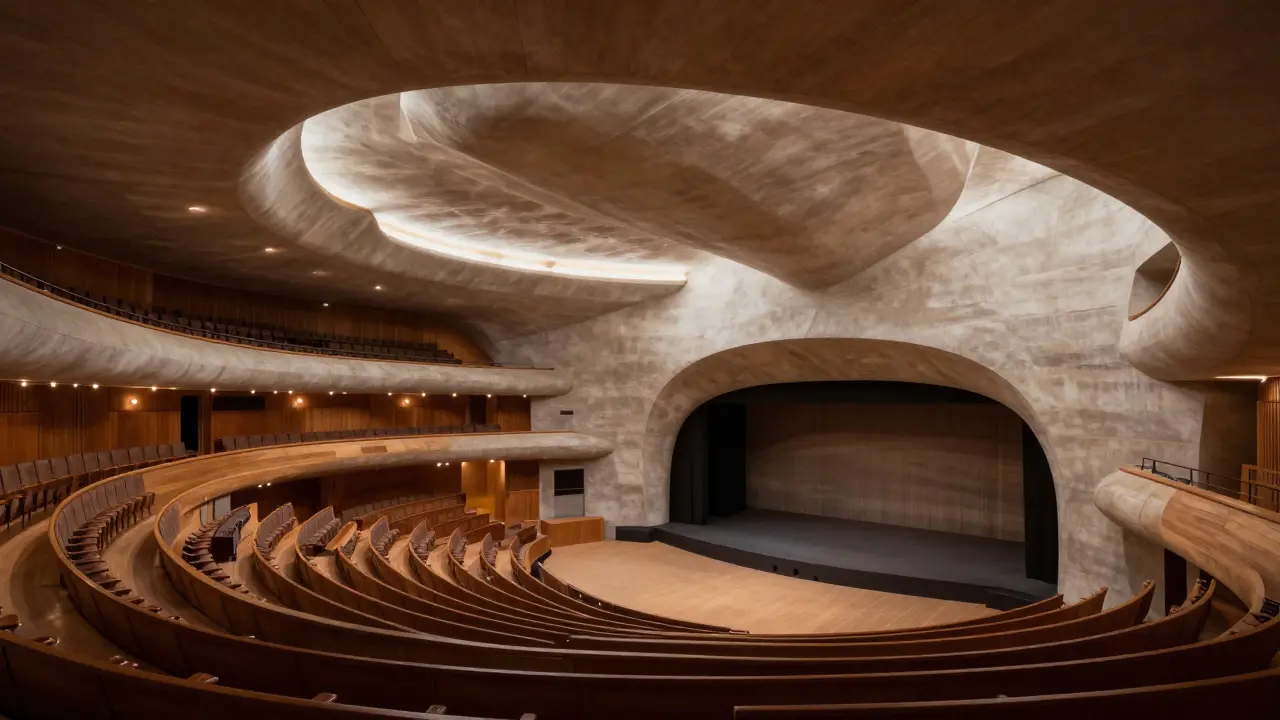
Then there’s Hans Scharoun, known for his organic approach. His Schaubühne Theater in Berlin features a ship-like hull floating above the ground. Inside, the seating area resembles a whale’s belly, curving around the stage to immerse the audience. Scharoun believed that spaces should adapt to human movement, not force humans into static rows. His work bridges the gap between Expressionism and later Organic Architecture movements.
In Vienna, Friedrich Kiesler designed the Endless House (though never fully built) and the Museum of Tomorrow. These projects featured continuous, flowing spaces without corners, challenging the traditional box-shaped room. Kiesler’s work anticipated the open-plan living concepts we see today, but with a surreal, dreamlike quality.
| Architect | Famous Work | Location | Key Feature |
|---|---|---|---|
| Ernst Neufert | Einstein Tower | Potsdam, Germany | Rubble masonry, cave-like forms |
| Hans Scharoun | Schaubühne Theater | Berlin, Germany | Organic, ship-like structure |
| Friedrich Kiesler | Museum of Tomorrow | New York (Concept) | Continuous flow, no corners |
| Hugo Häring | Brick Houses | Berlin, Germany | Expressive brickwork patterns |
The Decline and Legacy
So, if Expressionist Architecture was so innovative, why did it disappear? The short answer is money and politics. The style was incredibly expensive to build. Curved walls require custom molds, skilled labor, and complex engineering. After World War I, Europe was bankrupt. Governments needed cheap, fast housing for millions of displaced people. Rational, standardized Modernism-led by figures like Le Corbusier-offered exactly that: efficient, affordable, and mass-producible.
Additionally, the rise of Nazism in Germany led to the condemnation of Expressionist art as "degenerate." Many architects fled, taking their ideas with them to America and beyond. The style didn’t die out completely, though. It went underground, influencing Surrealism, Futurism, and eventually Postmodernism.
Today, you can see its DNA in the works of architects like Frank Gehry and Zaha Hadid. Gehry’s Guggenheim Museum in Bilbao, with its titanium curves, is a direct descendant of Expressionist principles. Hadid’s Heydar Aliyev Center flows like liquid concrete, echoing the organic forms of Scharoun and Neufert. Even video game environments and sci-fi film sets borrow heavily from Expressionist aesthetics to create worlds that feel emotionally charged and otherworldly.
Why It Still Matters Today
We live in a world of algorithms and smart homes. Our buildings are optimized for energy efficiency, data collection, and user convenience. But sometimes, we forget that architecture is also about feeling. Expressionist Architecture reminds us that a building can make you feel small, inspired, uneasy, or free. It challenges the notion that function is the only metric that matters.
When you walk into a space that makes your heart race or your breath catch, you’re experiencing the ghost of Expressionism. It’s not just a historical footnote; it’s a reminder that design has the power to touch the soul. Next time you see a twisting skyscraper or a museum with bizarre angles, remember: it started with a group of brave architects who decided to let their emotions speak louder than their blueprints.
What is the main difference between Expressionist Architecture and Modernism?
Modernism focuses on functionality, simplicity, and industrial materials like steel and glass in clean, geometric forms. Expressionist Architecture prioritizes emotional impact, using distorted, dynamic, and often irregular forms to evoke feelings, regardless of practical efficiency.
Why did Expressionist Architecture decline after the 1920s?
It declined due to high construction costs, economic instability after WWI, and political opposition. The Nazi regime labeled it "degenerate art," forcing many practitioners to flee. Meanwhile, the demand for cheap, mass-produced housing favored the simpler Modernist style.
Are there any famous Expressionist buildings still standing?
Yes. The Einstein Tower in Potsdam, Germany, is the most iconic surviving example. Other notable structures include parts of the Bauhaus Dessau campus (though more Modernist, it has Expressionist roots) and various residential houses in Berlin designed by Hugo Häring and Hans Scharoun.
How does Expressionist Architecture influence contemporary design?
Contemporary architects like Frank Gehry and Zaha Hadid use similar principles of fluid, non-linear forms. The style also influences entertainment design, including theme parks, movie sets, and video games, where creating an emotional atmosphere is more important than structural realism.
Is Expressionist Architecture considered part of the Modernist movement?
It is often grouped under the broader umbrella of Early Modernism, but it is distinct. While both rejected historical revivalism, Expressionism embraced emotional distortion and organic forms, whereas mainstream Modernism moved toward rationality, standardization, and minimalism.