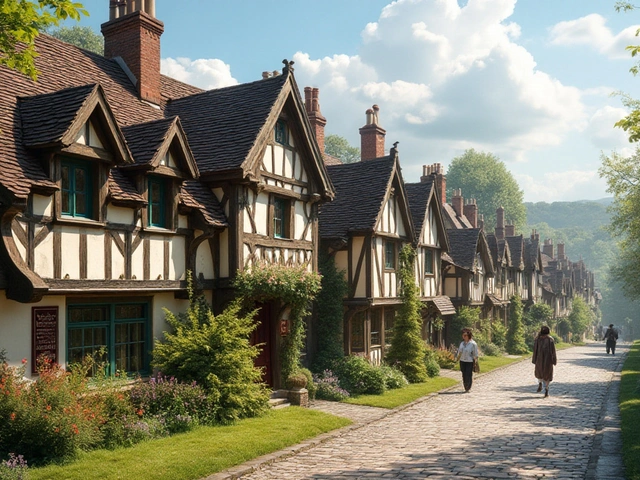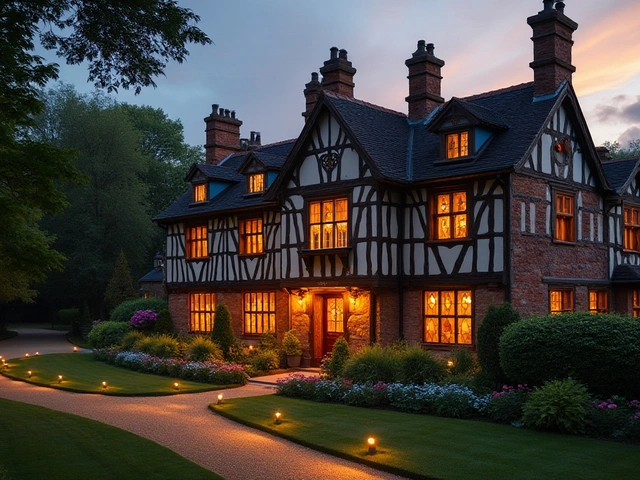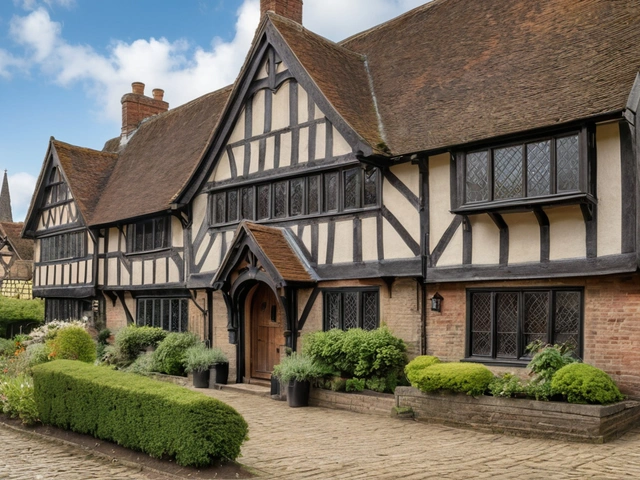
Walk past a classic English manor or a suburban home in the American Midwest, and you might spot it immediately: those dark wooden beams crisscrossing against white walls. It’s striking. It feels old-world, sturdy, and undeniably charming. But have you ever stopped to wonder why those beams are there? Are they just decoration, or do they hold up the house?
The answer is a mix of both, depending on when and where the building was constructed. Tudor architecture isn’t just one thing. It spans roughly two centuries, from the late 15th century through the early 17th century, covering the reigns of Henry VII, Henry VIII, Edward VI, Mary I, and Elizabeth I. During this time, English building styles shifted dramatically from the heavy, fortress-like medieval structures to more elegant, domestic residences.
If you’re looking at a house today labeled "Tudor," you need to know whether it’s an original historic structure or a 20th-century revival. The details tell the story. Let’s peel back the plaster and look at the bones of these buildings.
The Skeleton: Understanding Half-Timbering
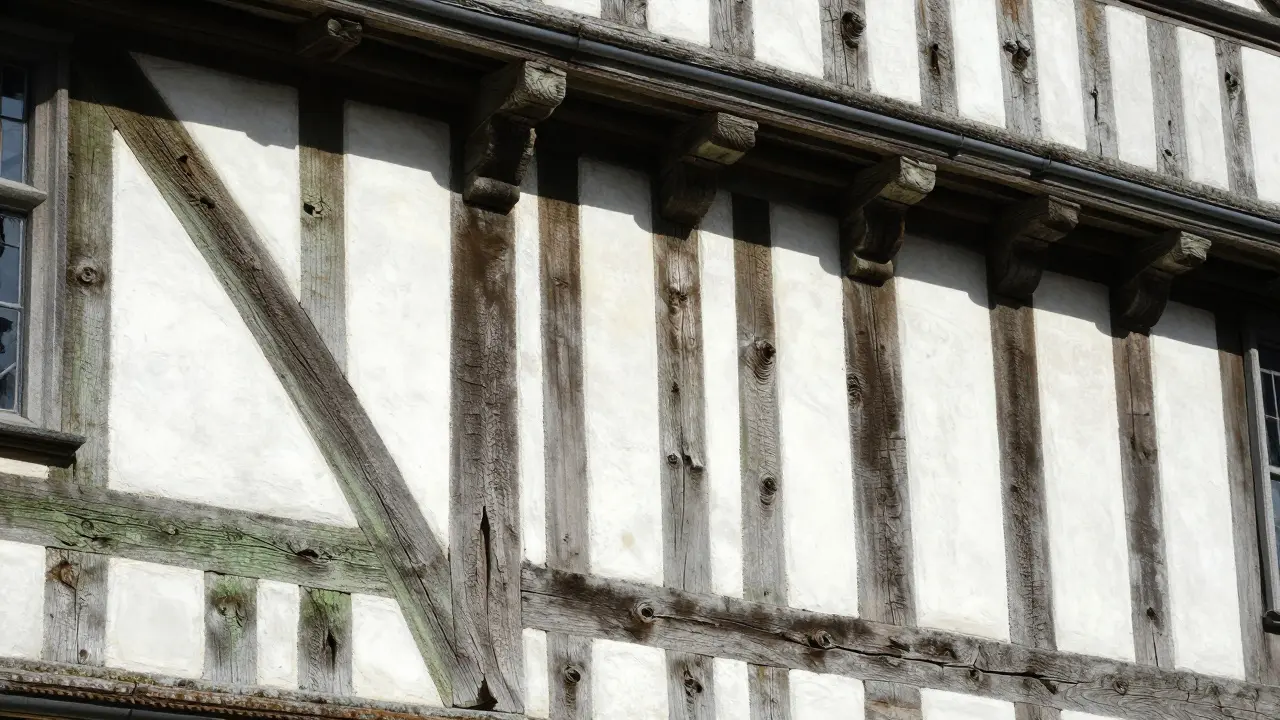
The most iconic feature of Tudor style is half-timbering, also known as jettying or exposed framing. In the original Tudor period (1485-1603), this wasn’t aesthetic flair; it was necessity. Stone was expensive and hard to transport. Timber was abundant. Builders created a structural frame using oak beams-vertical posts, horizontal girts, and diagonal braces-and filled the gaps with wattle and daub.
Wattle and daub consists of a woven lattice of wooden strips (wattle) plastered with a sticky mixture of wet soil, clay, sand, animal dung, and straw (daub). This material dried hard, providing insulation and weatherproofing. Over time, the daub was often whitewashed with lime, creating that high-contrast black-and-white look we associate with the style.
| Feature | Original Tudor (1485-1603) | Tudor Revival (1920s-Present) |
|---|---|---|
| Framing Material | Oak timber (structural) | Pine or fir (often decorative) |
| Infill | Wattle and daub (organic) | Brick, stone, or stucco |
| Beam Appearance | Irregular, hand-hewn, greenish-gray | Uniform, stained dark brown/black |
| Jettying | Common (upper floors overhang) | Rare (usually flat alignment) |
In the 20th-century Tudor Revival, which became popular in the US and UK after World War I, the timber beams were often non-structural. They were applied to brick or concrete block walls purely for visual effect. If you see perfectly uniform, dark-stained beams on a suburban ranch-style house, you’re likely looking at a revival, not a historical artifact. The difference matters because original Tudor homes require specialized maintenance to prevent rot in the organic infill, while revivals are easier to maintain but lack the thermal mass of traditional materials.
Windows That Tell a Story
Look up. What kind of windows do you see? In genuine Tudor architecture, windows are small compared to modern standards. Glass was incredibly expensive and difficult to produce in large sheets. Therefore, Tudor builders used mullioned windows.
A mullioned window has vertical bars (mullions) and horizontal bars (transoms) made of wood or stone, dividing the opening into many small panes. These weren’t just functional; they were status symbols. A large mullioned window meant the owner could afford the glass and the craftsmanship. You’ll often see these windows projecting outward from the wall, known as oriel windows. An oriel window rests on a corbelled bracket rather than extending to the ground, allowing light to enter without sacrificing interior floor space.
Another key detail is the casement style. Unlike modern double-hung sash windows that slide up and down, Tudor casements hinge on the side, like a door. They open outward, which helps shed rain away from the interior-a practical design choice given the leaky nature of early glazing compounds.
The Roofline: Steep Pitch and Chimneys
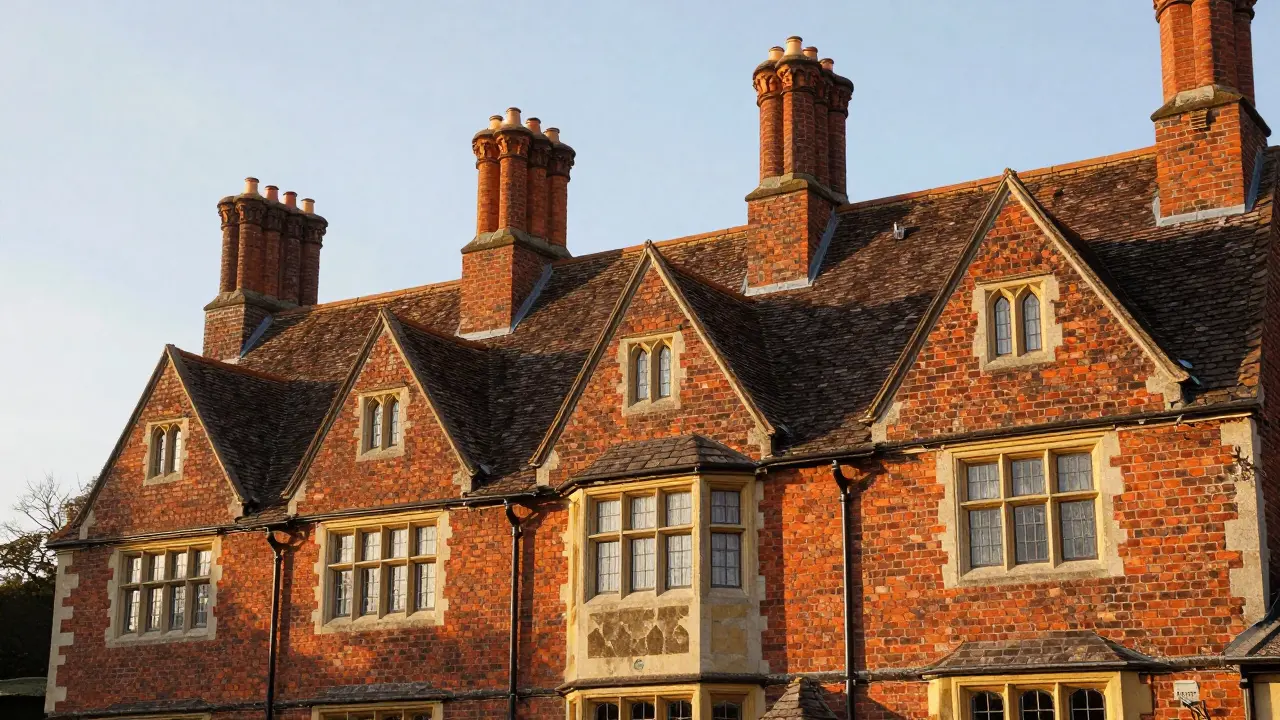
If the walls define the body of Tudor architecture, the roof defines its character. Tudor roofs are steeply pitched, often exceeding a 60-degree angle. Why so steep? To shed snow and rain quickly. Flat roofs would accumulate water, leading to leaks in the thatch or tile roofing materials commonly used at the time.
But the real stars of the Tudor skyline are the chimneys. In earlier medieval periods, houses had central hearths with smoke escaping through holes in the roof. By the Tudor era, fireplaces moved to the exterior walls, necessitating external chimneys. These weren’t simple bricks stacked up. They were elaborate, decorative structures.
Expect to see:
- Multiple stacks: A single chimney breast might serve several fireplaces on different floors, resulting in multiple flues emerging from one massive structure.
- Decorative capping: Chimney pots were often topped with terracotta pots, crockets (decorative knobs), or even shaped like human figures or animals.
- Asymmetry: Tudor chimneys are rarely centered. They jut out from the gable ends or the middle of the roof slope, adding a whimsical, uneven silhouette to the building.
This asymmetry is a hallmark of the style. Perfect symmetry belongs to the later Classical and Georgian periods. Tudor buildings embrace irregularity, reflecting their organic growth over time.
Doors and Entrances: The Grand Gesture
Enter through the main door, and you’ll likely encounter a Tudor arch. Also called a four-centered arch or depressed arch, this shape is flatter than a semicircle. It’s created by drawing arcs from four different centers, resulting in a pointed but gentle curve. This arch type is structurally efficient for wide openings and became a signature of the period.
For grander homes, the entrance might be framed by a porch with intricate carvings. Look for motifs like:
- Rosettes: Circular floral patterns carved into stone or wood.
- Chevron patterns: Zigzag designs often found in flooring or beam joints.
- Heraldry: Coats of arms carved above the door, indicating the family lineage or royal patronage.
The doors themselves were heavy oak, often reinforced with iron hinges and studs. Security was a concern, even for wealthy homeowners, so doors were thick and difficult to force open.
Interior Details: Paneling and Fireplaces
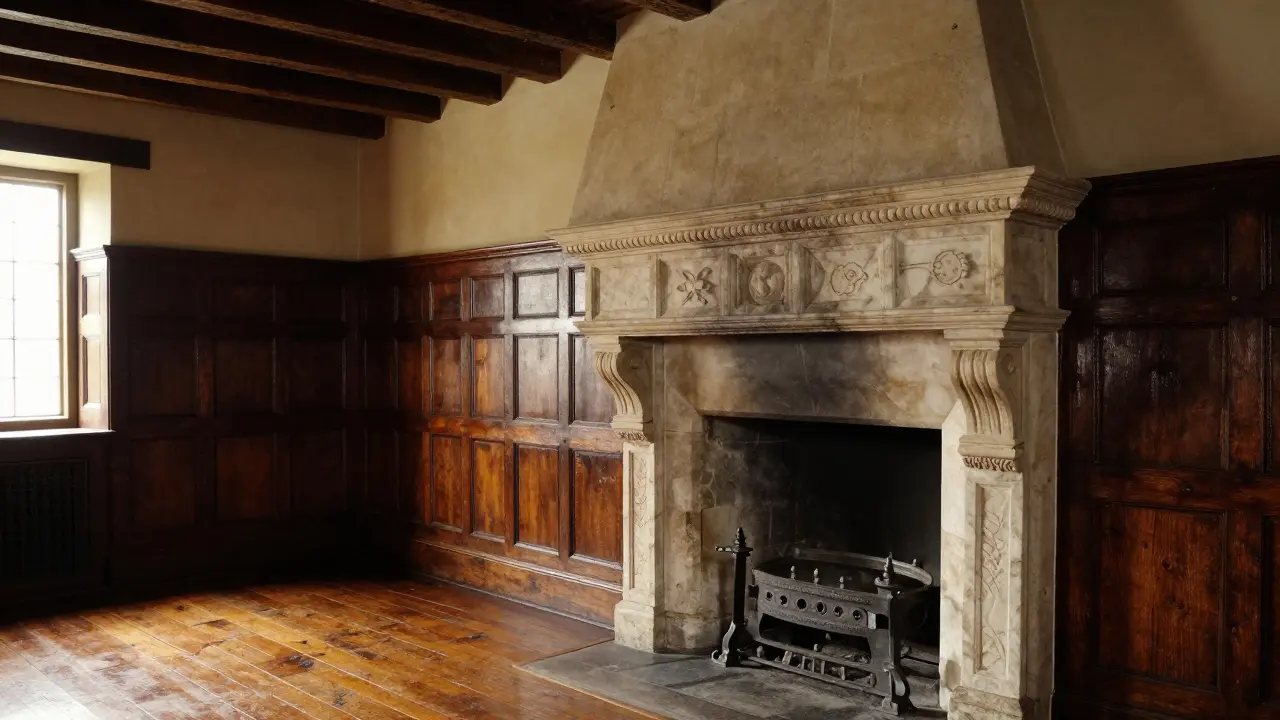
Step inside, and the ornate details continue. Cold drafts were a major issue in stone and timber houses, so interiors were lined with wood paneling. Oak was the preferred material due to its durability and resistance to warping.
Paneling wasn’t just plain boards. It featured raised panels, sometimes carved with geometric patterns, foliage, or biblical scenes. The lower part of the wall (the dado rail) was protected from furniture damage, while the upper panels added warmth and acoustics.
Fireplaces dominated the rooms. They were massive, built into the center of the room in earlier Tudor homes, then moved to the walls. The mantels were often made of stone or marble, carved with intricate designs. Above the fireplace, you might find a chimney piece with heraldic badges or mottoes inscribed in Latin.
Why Does This Matter Today?
Understanding these details helps you appreciate the craftsmanship of the past and make informed decisions if you own or restore a Tudor-style property. Original Tudor homes are rare and require sensitive conservation. Using modern vinyl siding or plastic windows can destroy their historical integrity and value.
For architects and designers, Tudor principles offer lessons in sustainability. Thick walls, natural materials, and passive solar orientation (south-facing windows) provide energy efficiency without relying on complex technology. The charm of Tudor architecture lies in its honesty-materials are used for what they are, and structure is expressed rather than hidden.
What is the difference between Tudor and Gothic architecture?
Gothic architecture, prevalent before the Tudor period, is characterized by pointed arches, ribbed vaults, and flying buttresses, primarily seen in cathedrals and churches. Tudor architecture is a domestic evolution that retains some Gothic elements like pointed arches but introduces more horizontal lines, larger windows, and decorative half-timbering. Think of Gothic as vertical and spiritual, while Tudor is horizontal and residential.
Are all black-and-white houses Tudor?
Not necessarily. While half-timbering is a key Tudor feature, similar techniques were used in other periods and regions, such as the Hanseatic League cities in Northern Europe. Additionally, many 20th-century homes mimic the look without being historically Tudor. To confirm, look for construction dates, joinery methods, and local historical records.
What is a jetty in Tudor architecture?
A jetty is when an upper floor of a building projects beyond the footprint of the floor below it. This was done to maximize interior space on narrow urban plots without violating street width regulations. Jetties are supported by wooden brackets or corbels and are a distinctive feature of many surviving Tudor townhouses.
How can I identify a fake Tudor beam?
Fake or revival beams are usually perfectly straight, uniformly stained, and attached to the surface of a wall rather than integrated into the structure. Original Tudor beams are often irregular in shape, show tool marks from hand-hewing, and may have a greenish-gray patina from age. They also connect to other beams with mortise-and-tenon joints, not nails or screws.
Is Tudor architecture still popular today?
Yes, particularly in the form of Tudor Revival. Many suburban neighborhoods built in the mid-20th century feature simplified Tudor elements like steep roofs and brick exteriors. While pure Tudor design is rare in new construction, its aesthetic influence persists in cottage-style homes and custom builds seeking a cozy, traditional feel.