
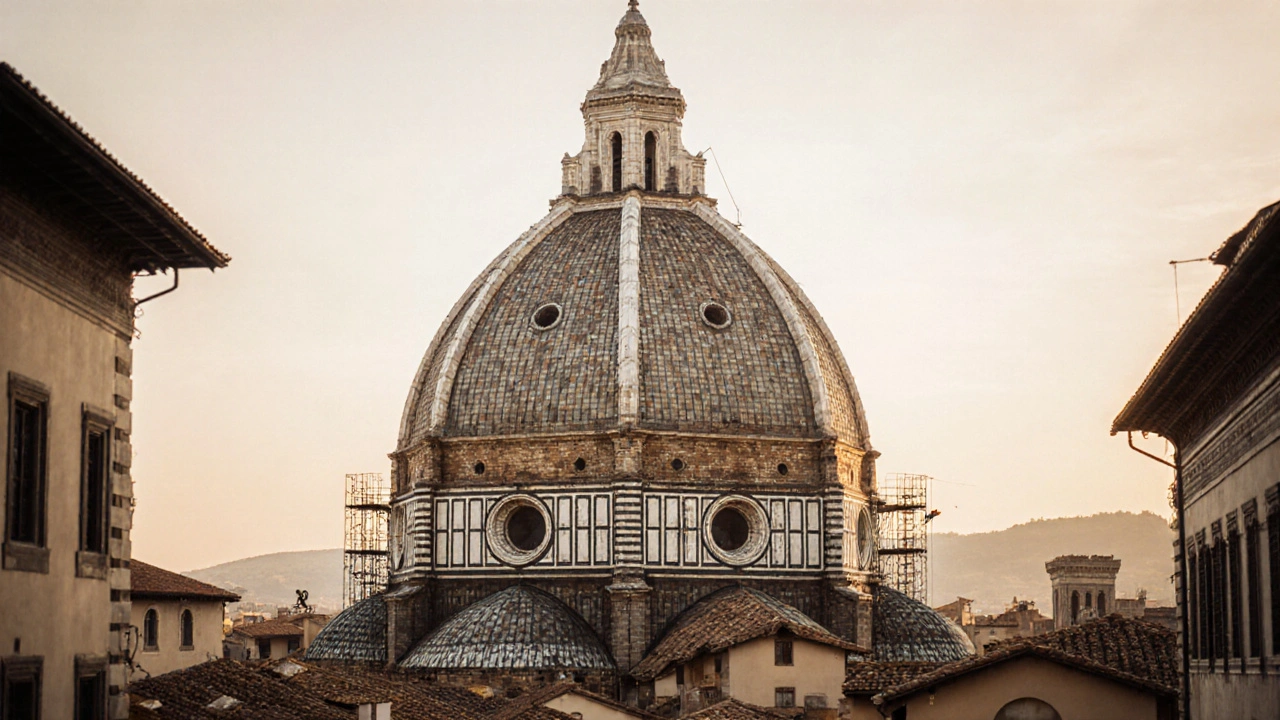
Renaissance architecture fused art and science to create buildings based on harmony, proportion, and human reason. From Brunelleschi’s dome to Palladio’s villas, its legacy still shapes how we design spaces today.
Linear Perspective in Architecture: How Depth and Space Shape Real-World Design
When you look at a drawing of a long hallway or a row of identical buildings fading into the distance, you’re seeing linear perspective, a system for creating the illusion of depth on a flat surface using converging lines and a single vanishing point. Also known as one-point perspective, it’s the reason architectural renderings feel real—even when they’re just ink on paper. Before this method was formalized in the early 1400s, buildings in art looked flat, stacked, or randomly sized. Then Filippo Brunelleschi cracked the code: if all parallel lines lead to one spot on the horizon, your brain accepts the scene as three-dimensional. That single insight changed how architects designed, how artists painted spaces, and how we still visualize buildings today.
Linear perspective isn’t just an old art trick—it’s the backbone of how architects communicate ideas. Whether you’re sketching a house on a napkin or rendering a skyscraper in 3D software, you’re using the same rules: parallel lines converge, objects get smaller as they recede, and the horizon line sets the viewer’s eye level. You can spot it in Renaissance architecture, the 15th-century movement that revived classical proportions and introduced mathematical precision into building design, like in Brunelleschi’s Ospedale degli Innocenti, where the arcade’s arches shrink evenly toward a central point. It’s also why architectural drawing, the precise visual language used by designers to plan and present structures still relies on grids, orthographic views, and perspective sketches—even in the age of CAD and VR. Without it, you couldn’t tell if a room was 10 feet wide or 100.
Modern architects don’t just use linear perspective to draw buildings—they use it to control how people feel inside them. A long corridor with strong perspective lines can feel dramatic, even intimidating. A living room drawn with a low horizon line makes the ceiling feel higher. The vanishing point isn’t just a technical mark—it’s a psychological tool. That’s why you’ll see it in spatial design, the intentional arrangement of space to guide movement, focus attention, and evoke emotion in museums, airports, and even retail stores. It’s not magic. It’s math made visible.
What you’ll find below are posts that show how linear perspective shaped the buildings we admire—from the grand halls of Renaissance palaces to the clean lines of modern homes. You’ll see how it connects to symmetry in Georgian houses, how it hides in the depth of Italianate cornices, and why even expressionist buildings still rely on it to feel grounded. This isn’t about drawing techniques. It’s about how we see the world—and how architects have learned to shape that vision for over 600 years.