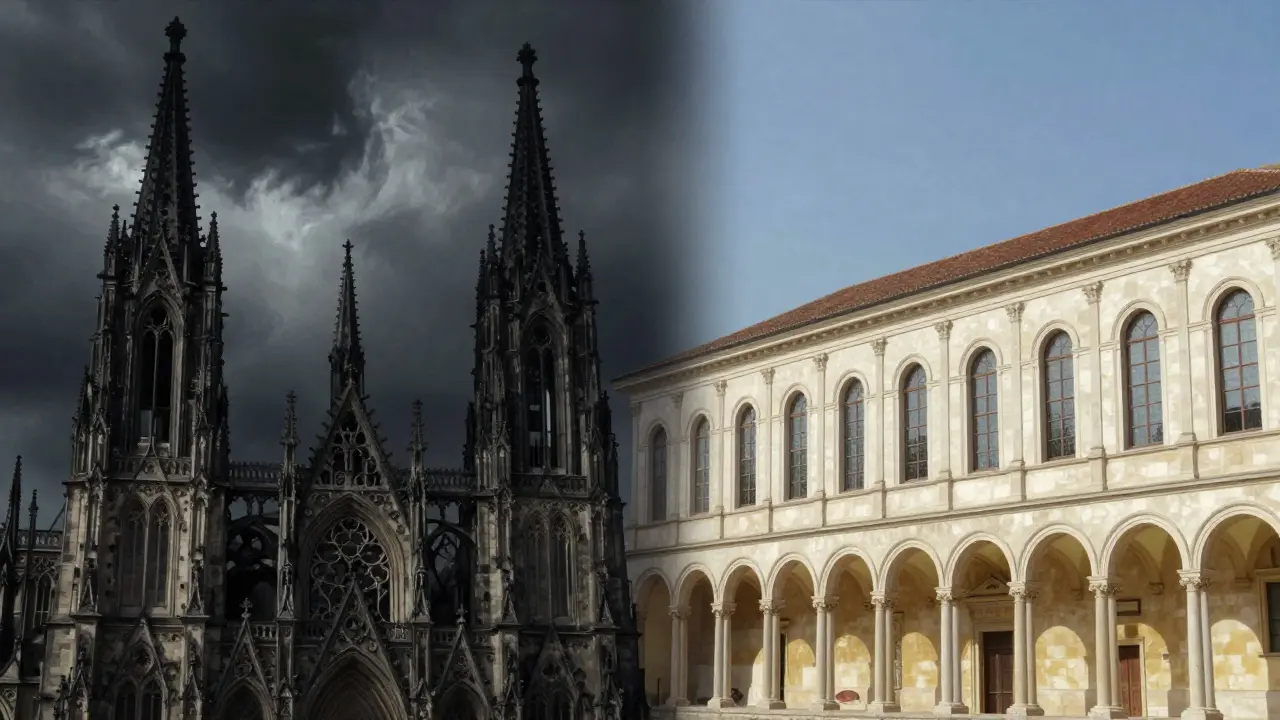
Have you ever walked into a building and felt an immediate sense of calm, order, and balance? That feeling often comes from Renaissance architecture. It is not just about pretty facades or grand domes; it is a deliberate return to logic, proportion, and the human experience. While Gothic cathedrals reached for heaven with pointed spires and intricate complexity, Renaissance builders looked back to ancient Rome and Greece. They wanted structures that made sense to the eye and the mind.
This architectural movement didn't happen overnight. It started in Florence, Italy, in the early 1400s and spread across Europe over the next two centuries. But why does it still matter today? Because the principles of Renaissance design-symmetry, geometry, and the use of classical elements-are the foundation of much of the built environment we see in government buildings, banks, and universities around the world. Understanding this style helps us appreciate not just history, but the language of space itself.
The Return to Classical Roots
To understand Renaissance architecture, you have to look at what came before it. The Middle Ages were dominated by the Gothic style, which featured ribbed vaults, flying buttresses, and stained glass. It was dramatic, vertical, and often dark inside. Then, something shifted. Scholars began rediscovering the writings of Vitruvius, a Roman architect who wrote about architecture in the first century BC. His treatise, *De Architectura*, emphasized three key qualities: firmitas (strength), utilitas (utility), and venustas (beauty).
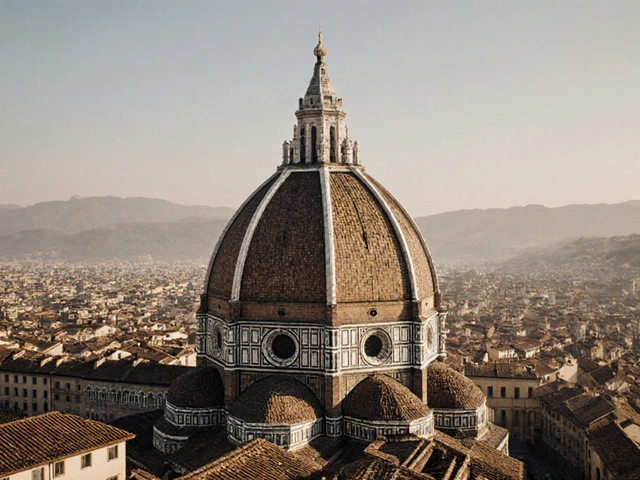
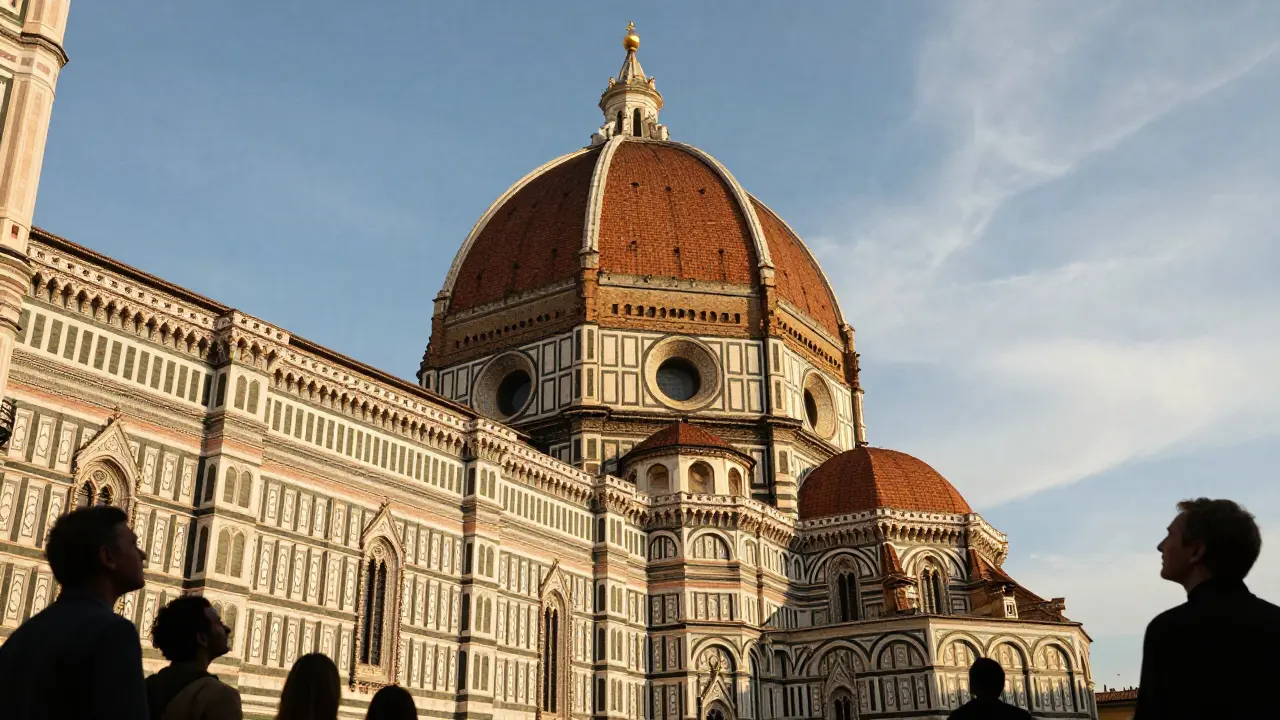
Filippo Brunelleschi, widely considered the father of Renaissance architecture, took these ideas seriously. He studied the ruins of Rome, measuring columns and arches to understand how the ancients built without modern machinery. In 1418, he won the competition to design the dome for the Florence Cathedral. This wasn't just an engineering feat; it was a statement. The dome echoed the Pantheon in Rome, signaling a clear break from the Gothic past. Brunelleschi proved that large-scale construction could be both mathematically precise and visually harmonious.
This revival wasn't just aesthetic; it was philosophical. The Renaissance was about humanism-the idea that humans are the measure of all things. Buildings were no longer just shells for worship; they were spaces designed for human comfort and intellectual engagement. The scale changed. Instead of towering ceilings that made you feel small, rooms became proportional to the human body. Corridors were widened, windows were enlarged, and light flooded in. The focus shifted from the divine mystery to human clarity.
Core Principles: Symmetry, Proportion, and Geometry
If you want to spot a Renaissance building, look for symmetry. Unlike the asymmetrical layouts of medieval castles or churches, Renaissance plans are often based on simple geometric shapes like squares and circles. Imagine a building where if you draw a line down the middle, the left side mirrors the right perfectly. This isn't just for looks; it reflects a belief in cosmic order. The universe, thinkers argued, was governed by mathematical laws, and buildings should reflect that harmony.
Proportion is the other half of this equation. Architects used ratios derived from music theory and human anatomy. For example, the height of a room might be exactly twice its width, creating a 'perfect' rectangle. These proportions weren't arbitrary. They were believed to create a psychological effect of peace and stability. When you walk into a room with correct proportions, your brain registers it as 'right,' even if you can't explain why.
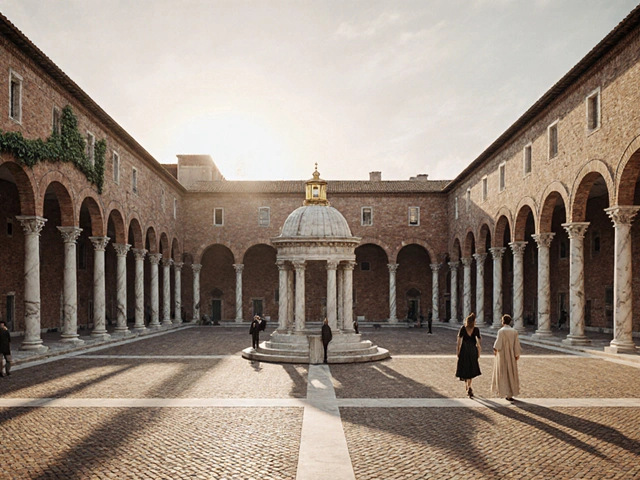
Geometry also dictated the layout of entire complexes. Think of the ideal city plan, with streets radiating from a central square. This concept influenced urban planning far beyond Italy. Even today, many university campuses and government districts follow these radial or grid-based patterns because they promote efficient movement and visual coherence. The use of the circle, representing perfection and eternity, appeared frequently in floor plans and domes. The Tempietto in Rome, designed by Donato Bramante, is a perfect example-a small, circular temple that embodies the era's love for geometric purity.
| Feature | Gothic/Medieval | Renaissance |
|---|---|---|
| Shape Preference | Complex, irregular | Simple, geometric (square, circle) |
| Verticality | High, soaring heights | Horizontal emphasis, balanced heights |
| Lighting | Dim, colored through stained glass | Bright, natural light through large windows |
| Structural Logic | Hidden supports (buttresses) | Visible, logical load-bearing walls |
| Philosophy | Divine mystery, awe | Human reason, clarity |
The Language of Columns and Orders
You cannot talk about Renaissance architecture without mentioning the classical orders. These are standardized systems for designing columns and facades, inherited from ancient Greece and Rome. There are five main orders: Doric, Ionic, Corinthian, Tuscan, and Composite. Each has distinct features. Doric columns are sturdy and plain, with no base. Ionic columns have scrolls (volutes) at the top. Corinthian columns are ornate, decorated with acanthus leaves.
Renaissance architects didn't just copy these styles; they codified them. Books were published showing exactly how to construct each order, complete with measurements. This standardization allowed architects in different countries to speak the same visual language. A bank in London could look similar to a palace in Venice because they both used the same rules for column spacing, entablature height, and capital decoration.
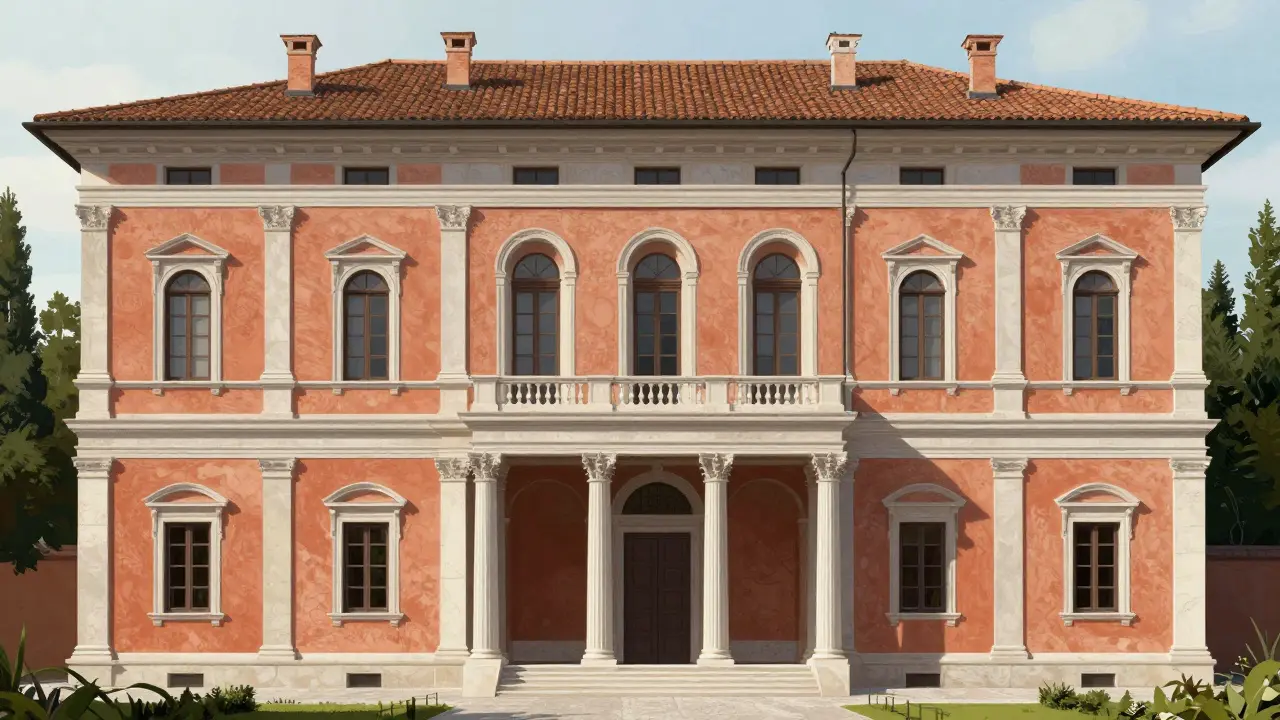
The placement of orders mattered too. Often, heavier orders like Doric or Tuscan were placed on the ground floor to suggest stability, while lighter, more decorative orders like Ionic or Corinthian were used on upper floors. This created a visual hierarchy that guided the eye upward. Facades became layered compositions, with pilasters (flat, rectangular columns attached to walls) framing windows and doors. This rhythm of solid and void-wall versus window-created a pleasing pattern that defined the street scene.
Key Masters and Their Masterpieces
Several figures shaped this movement, each adding their own twist to the classical formula. After Brunelleschi, Leon Battista Alberti wrote extensively about architecture, arguing that beauty was a harmony of parts. He designed the facade of Santa Maria Novella in Florence, using geometric grids to align every element perfectly. His work showed how theory could translate directly into practice.
Later, Andrea Palladio took these ideas further. Working in the Veneto region of Italy, he focused on villas for wealthy landowners. Palladio’s designs were practical yet elegant, featuring symmetrical plans, porticos with classical columns, and interiors organized around a central hall. His book, *The Four Books of Architecture*, became the most influential architectural text in history. It was translated into English and French, spreading his style across Europe and eventually to America.
In Rome, Michelangelo brought a more sculptural approach. While earlier Renaissance architects favored restraint, Michelangelo introduced bold, heavy forms. His redesign of the Piazza del Campidoglio in Rome features trapezoidal shapes and giant orders (columns that span multiple stories), breaking some of the strict rules set by his predecessors. This shift marked the transition from High Renaissance to Mannerism, where emotion and drama began to outweigh pure rationality.
Spread Across Europe and Beyond
The Renaissance didn't stay confined to Italy. As trade routes expanded and diplomats traveled, the style moved north. In France, the Château de Chambord blends traditional French medieval fortifications with Italian Renaissance details like spiral staircases and symmetrical windows. In England, the style arrived later, evolving into what we now call Elizabethan and Jacobean architecture. Hampton Court Palace shows this mix, with Tudor brickwork meeting Italianate fireplaces and corridors.
In Northern Europe, the style adapted to local materials. Brick replaced stone in places like Germany and the Netherlands, leading to distinct regional variations. Yet the core principles remained: symmetry, classical detailing, and proportion. By the 17th century, the Renaissance had evolved into Baroque, which added movement and curvature, but the foundational grammar of columns and pediments stayed intact.
Perhaps the most significant export was to the United States. Thomas Jefferson, an avid reader of Palladio, applied these principles to Monticello and the University of Virginia. The U.S. Capitol Building and the White House are direct descendants of Renaissance ideals. This connection explains why so many American civic buildings look alike-they share a common DNA rooted in 15th-century Florence.
Why Renaissance Architecture Endures
So, why do we still care about buildings from 500 years ago? One reason is longevity. Stone and brick, when built correctly, last for centuries. But there's also a psychological factor. Humans crave order. In a chaotic world, a building with clear lines, balanced proportions, and familiar classical elements provides a sense of stability. This is why neoclassical revivals happened repeatedly throughout the 18th, 19th, and 20th centuries. Governments chose this style to project authority, permanence, and democratic values.
Modern architects still study Renaissance techniques. The use of modular grids, the emphasis on natural light, and the integration of interior and exterior spaces are all lessons learned from this period. Even contemporary sustainable design echoes Renaissance concerns with passive heating and cooling through orientation and material choice.
Ultimately, Renaissance architecture teaches us that beauty is not accidental. It is the result of careful thought, mathematical precision, and respect for tradition. Whether you're walking through the Vatican, visiting a museum in Washington D.C., or simply passing a historic library, you're experiencing the legacy of a movement that put humanity-and reason-at the center of design.
What are the main characteristics of Renaissance architecture?
The main characteristics include symmetry, proportion, geometry, and the use of classical elements like columns, pilasters, lintels, semicircular arches, hemispherical domes, niches, and aedicules. Buildings often feature flat roofs behind cornices rather than pitched roofs, and facades are typically divided horizontally by stringcourses and vertically by pilasters.
Who is considered the founder of Renaissance architecture?
Filippo Brunelleschi is widely regarded as the founder. His design for the dome of the Florence Cathedral and his church of San Lorenzo demonstrated the new emphasis on mathematical proportion and classical revival, marking a decisive break from the Gothic style.
How did Renaissance architecture influence modern buildings?
It established the vocabulary of Western architecture, including the use of classical orders and symmetrical planning. Many government buildings, banks, and universities worldwide still use neoclassical designs inspired by Renaissance principles to convey stability, authority, and timeless elegance.
What is the difference between Gothic and Renaissance architecture?
Gothic architecture emphasizes verticality, pointed arches, and complex structural systems like flying buttresses to create tall, light-filled spaces. Renaissance architecture returns to horizontal balance, rounded arches, and classical proportions, focusing on symmetry, clarity, and human-scale dimensions.
Which famous buildings are examples of Renaissance architecture?
Notable examples include the Florence Cathedral dome by Brunelleschi, the Villa Rotonda by Andrea Palladio, St. Peter's Basilica in Vatican City (designed by several masters including Michelangelo), and the Palazzo Rucellai in Florence. In the US, the White House and the U.S. Capitol are prominent neoclassical derivatives.