

Renaissance architecture revived classical Roman and Greek design principles, emphasizing symmetry, proportion, and human scale. It transformed buildings from religious monuments into harmonious, rational spaces that still influence design today.
Brunelleschi: The Architect Who Redefined Renaissance Design
When you think of Brunelleschi, the Italian architect and engineer who pioneered linear perspective and built the first major dome of the Renaissance. Also known as Filippo Brunelleschi, he didn’t just design buildings—he redefined what was possible with stone, brick, and human ingenuity. Before him, no one had built a dome larger than Rome’s Pantheon. Then came the Florence Cathedral—its massive open space left without a roof for decades. The city needed a solution, and Brunelleschi didn’t wait for permission. He built a dome that defied gravity, using no centering, no wooden scaffolding, and no one else’s methods. His dome still stands today, taller than the Statue of Liberty, and it’s the reason we even talk about architectural innovation.
He didn’t stop at the dome. Brunelleschi also invented the linear perspective, a mathematical system for creating the illusion of depth on a flat surface, which changed how artists and architects saw space. This wasn’t just art—it was a tool that made buildings feel real before they were built. His work influenced every architect who came after him, from Michelangelo to modern designers who still study his drawings. He was also one of the first to treat architecture as a science, mixing math, physics, and craftsmanship into a single discipline. You can see his fingerprints on Renaissance architecture, the style that revived classical forms with new precision and human-centered proportions—symmetrical facades, harmonious ratios, and clean lines that still define elegant design today.
His legacy isn’t locked in museums. It’s in the way buildings breathe, the way light falls through windows, the way a structure feels balanced. The Florence Cathedral, also known as Santa Maria del Fiore, with its iconic red-tiled dome isn’t just a tourist stop—it’s a working textbook. The way he designed the double-shell structure, the herringbone brick pattern, the chain of stone to hold the dome together—these are still taught in engineering schools. And if you’ve ever admired a modern building with a clean, soaring roof or a perfectly proportioned facade, you’re seeing Brunelleschi’s shadow.
Below, you’ll find posts that dig into the movements he inspired, the buildings he influenced, and the ideas that still shape how we build today. From Baroque drama to Renaissance symmetry, these articles show how one man’s stubborn brilliance became the foundation for centuries of design.
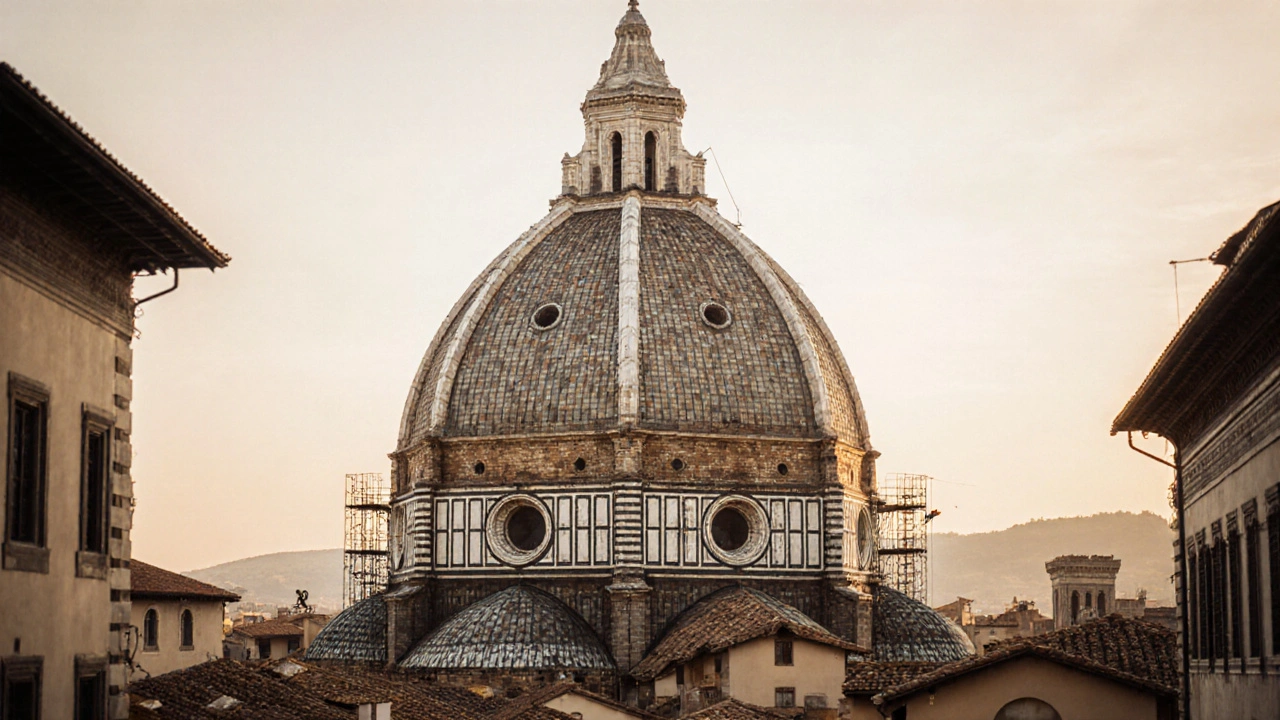
Renaissance architecture fused art and science to create buildings based on harmony, proportion, and human reason. From Brunelleschi’s dome to Palladio’s villas, its legacy still shapes how we design spaces today.