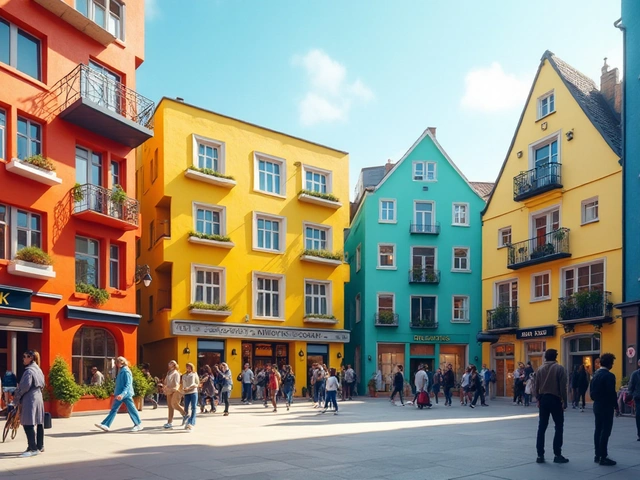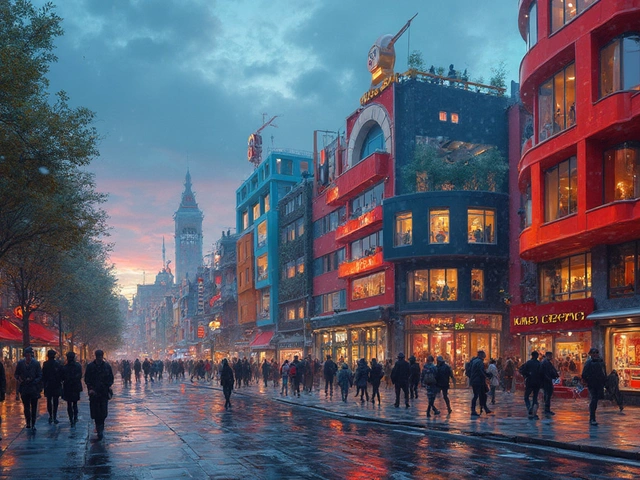

When you walk down a street in downtown Memphis or downtown Sydney, you might see a building that looks like it’s wearing a joke - a pink column topped with a giant capital letter, a gable roof that doesn’t match the rest of the facade, or a pediment that’s been stretched like taffy. That’s not a mistake. That’s postmodern architecture. And it wasn’t trying to be pretty. It was trying to be loud.
What Postmodern Architecture Actually Is
Modern architecture, from the 1920s to the 1970s, believed in one thing: less is more. Glass towers, steel frames, clean lines, no decoration. Think Le Corbusier’s concrete boxes or Mies van der Rohe’s glass boxes. They wanted purity. Efficiency. Rationality.
Then came the rebels.
Postmodern architecture didn’t just break the rules - it laughed at them. It mixed styles. It borrowed from ancient Greece, Gothic cathedrals, Victorian houses, and even roadside diners. It used color like a kid with a new crayon box. It put classical columns on a shopping mall. It turned symmetry into a suggestion.
It wasn’t about function anymore. It was about meaning. About memory. About making people feel something - even if that feeling was confusion, amusement, or nostalgia.
Robert Venturi, the man who wrote the book that started it all, said it best: “Less is a bore.” That one line flipped the whole world of design on its head.
The Three Architects Who Changed Everything
Three names keep coming up when you talk about postmodern architecture’s roots: Robert Venturi, Charles Moore, and Michael Graves. Each had a different voice, but they all shouted the same message: architecture doesn’t have to be serious to be powerful.
Robert Venturi didn’t just design buildings - he wrote essays that became manifestos. His 1966 book, Complexity and Contradiction in Architecture, was the first real challenge to modernism. He looked at Las Vegas strip malls and saw genius. He argued that ordinary, commercial buildings - with their neon signs, fake facades, and mixed styles - were more honest than the cold, clean boxes modernists were building. His Vanna Venturi House in Philadelphia, built for his mother in 1964, looked like a child’s drawing of a house: a big, tilted gable, a tiny window, a chimney that didn’t connect to anything. It was wrong. And it was brilliant.
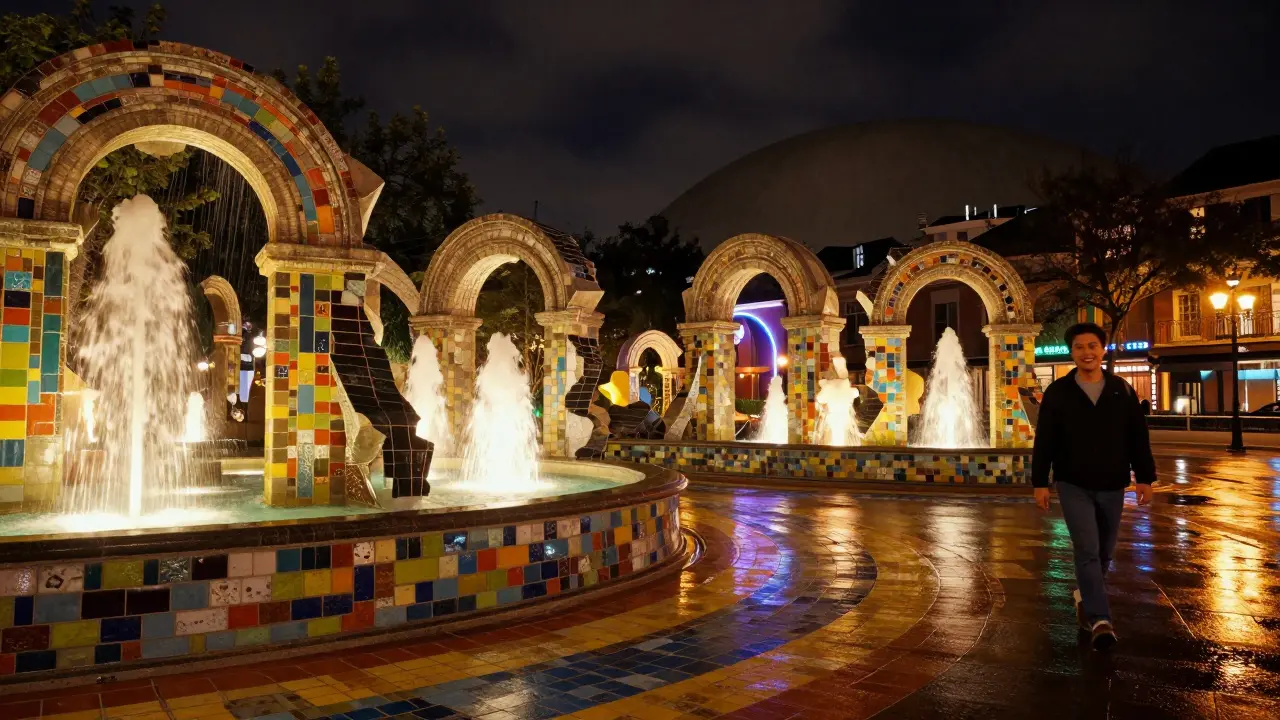
Charles Moore had a flair for drama. His Piazza d’Italia in New Orleans (1978) is still one of the most talked-about public spaces ever built. It’s a swirl of columns, arches, fountains, and colored tiles - all pulled from Roman, Renaissance, and Italian-American styles. It didn’t serve a practical purpose. No one used it as a meeting spot. But people went there anyway - because it made them smile. Moore didn’t design buildings for efficiency. He designed them for emotion. He once said, “Architecture should be a celebration, not a lecture.”
Michael Graves brought color and whimsy into the mainstream. His Portland Building (1982) in Oregon was the first major public building to go postmodern. It had giant, cartoonish columns, bright red and yellow accents, and a base that looked like a stack of candy boxes. Critics called it a joke. The public loved it. Graves later designed household items - teapots, toasters, even a line of Target kitchenware - that made postmodernism part of everyday life. He proved that architecture didn’t have to be monumental to be meaningful.
How Postmodernism Broke the Rules
Modern architecture had rules. Postmodernism broke them all.
- Decoration wasn’t evil - it was essential. Moldings, cornices, arches, and murals came back. Not as historical copies, but as playful references.
- Scale didn’t matter. A building could have a giant column next to a tiny window. A roof could be flat on one side and peaked on the other. Nothing had to match.
- History wasn’t dead. Gothic arches, Doric columns, and Baroque flourishes were reused, exaggerated, or twisted. They weren’t copied - they were quoted.
- Function was flexible. A building didn’t need to be efficient. It needed to tell a story.
Postmodern architects didn’t reject technology. They just refused to let it control the design. They used steel and glass - but they wrapped them in brick, painted them in neon, or gave them fake stone facades.
Think of it like music. Modernism was classical - strict, clean, predictable. Postmodernism was punk rock. It was loud. It was messy. It didn’t care if you liked it.

The Legacy: Where Postmodernism Lives Today
Postmodern architecture didn’t last as a dominant style. By the 1990s, it was being called excessive. Too much color. Too much irony. Too much noise.
But its DNA is everywhere.
Look at the Apple Store on Fifth Avenue. The glass cube is modernist. But the way it’s framed by the surrounding buildings? The way it plays with reflection and scale? That’s postmodern thinking.
Look at the Sydney Opera House. It’s often called modernist. But its shell-like forms? The way it references sails, shells, and even Aboriginal art? That’s postmodern symbolism.
Even today’s tech campuses - with their colorful facades, irregular shapes, and playful public spaces - owe something to Moore and Graves. Google’s headquarters in Mountain View? The giant slide? The rooftop gardens shaped like picnic tables? That’s not just about employee wellness. It’s about humanizing space. That’s postmodern.
And then there’s the rise of “contextual design.” Architects now study neighborhoods before they design. They ask: What colors are already here? What shapes do people recognize? What stories does this place tell? That’s not new. That’s Venturi, 50 years early.
Postmodernism didn’t die. It just went underground. It became a way of thinking, not a style.
Why It Still Matters
Today, we’re tired of bland. We’re tired of buildings that look like they were made by algorithm. We want character. We want quirks. We want places that feel like they were made for people, not just for function.
Postmodern architecture taught us that buildings can be funny. They can be nostalgic. They can be wrong - and still be right.
It reminds us that culture isn’t clean. It’s messy. It’s layered. It’s full of references, mistakes, and accidents.
When we design today, we don’t just ask: “Is it efficient?” We also ask: “Does it feel like home?” “Does it make you look twice?” “Does it remember where it came from?”
That’s the real legacy.
Postmodernism didn’t give us new materials. It gave us permission - permission to be human, to be playful, to be imperfect. And that’s something no glass tower ever could.
What is the main difference between modern and postmodern architecture?
Modern architecture focuses on simplicity, clean lines, and function - “less is more.” Postmodern architecture rejects that idea. It uses color, ornament, historical references, and irony. It says “less is a bore.” Where modernism was cold and uniform, postmodernism is playful, layered, and personal.
Who are the key figures in postmodern architecture?
Robert Venturi, Charles Moore, and Michael Graves are the three most influential pioneers. Venturi wrote the foundational book Complexity and Contradiction in Architecture. Moore created the wildly colorful Piazza d’Italia. Graves brought postmodern design into homes with his bold, colorful buildings and household products.
Is postmodern architecture still being built today?
Not as a dominant style, no. But its ideas are everywhere. Today’s architects use its lessons - mixing styles, using color, referencing history, and designing for emotion - even if they don’t call it postmodern. The movement’s spirit lives on in playful public spaces, colorful facades, and buildings that prioritize meaning over purity.
Why did postmodern architecture fall out of favor?
By the late 1980s and early 1990s, many postmodern buildings were seen as too gimmicky. Critics called them kitschy, superficial, or just too loud. Some buildings used historical references without understanding them, which felt disrespectful. As economic pressures grew, developers wanted cheaper, simpler designs. But its decline wasn’t because it failed - it was because it succeeded. It broke the rules so thoroughly that the next generation didn’t need to rebel anymore.
Can you give an example of a famous postmodern building?
The Portland Building in Oregon, designed by Michael Graves in 1982, is one of the most famous. It’s a government office tower with oversized columns, bright red and yellow accents, and a base that looks like stacked boxes. It was controversial at first - many called it a joke - but it became an icon. Another example is the AT&T Building (now 550 Madison) in New York, designed by Philip Johnson, with its broken pediment that looks like a Chippendale furniture piece.