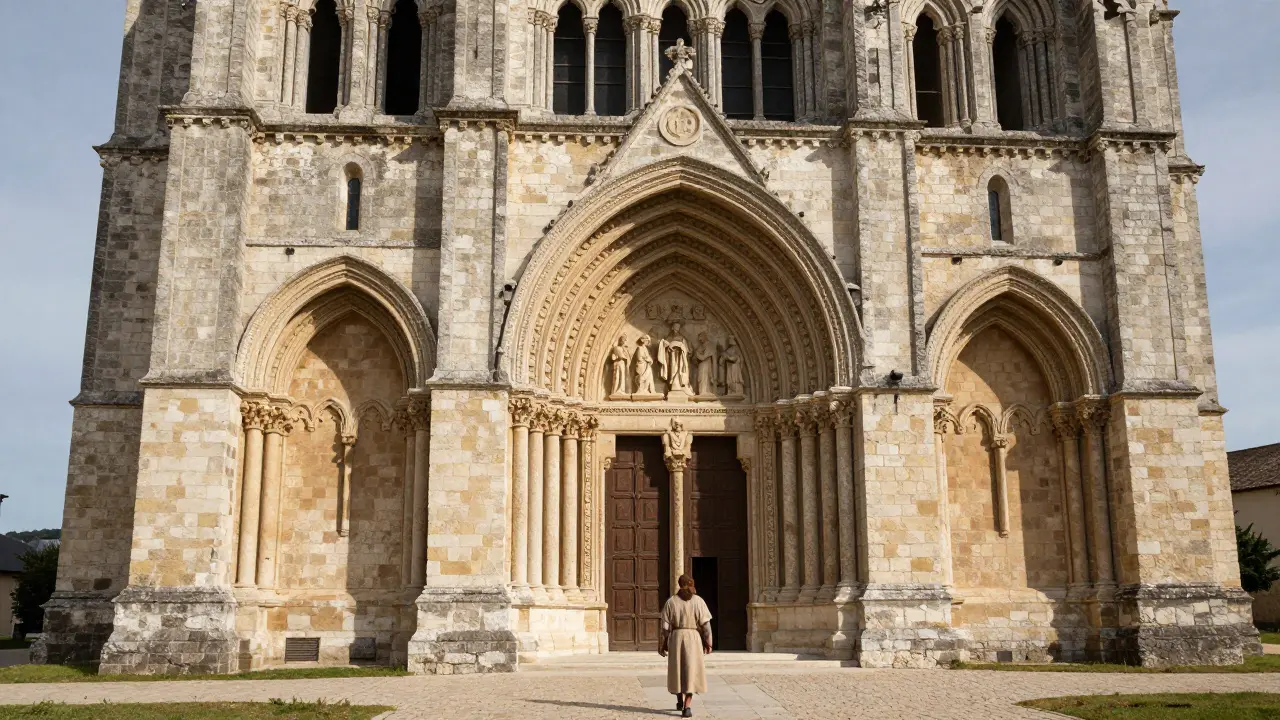
Picture this: a massive stone church with thick walls, small windows, and rounded arches. This is Romanesque architecture a style that emerged in Europe between the 10th and 12th centuries, becoming the first truly pan-European architectural language after the fall of Rome. It blended Roman engineering with medieval innovation, creating structures that were both functional and symbolic of a unified Christian Europe.. Unlike the delicate Gothic style that followed, Romanesque buildings feel grounded, sturdy, and fortress-like. This wasn’t accidental. Europe was recovering from centuries of instability, and churches needed to be defensible yet awe-inspiring. By 1100 AD, this style had spread from Spain to Scandinavia, shaping how people worshipped, traveled, and lived.
What Made Romanesque Architecture Unique?
Romanesque architecture wasn’t just about looks-it solved real problems. After the collapse of the Roman Empire, Europe lacked centralized power. Monasteries became centers of learning, trade, and safety. Builders needed structures that could withstand attacks, house large congregations, and support heavy stone ceilings. The solution? Thick walls, rounded arches, and barrel vaults. These elements distributed weight evenly, allowing for taller buildings than before. But unlike Gothic’s skeletal frames, Romanesque relied on sheer mass. A typical church wall might be 3 feet thick, made from locally quarried stone. This made construction slow but incredibly durable.
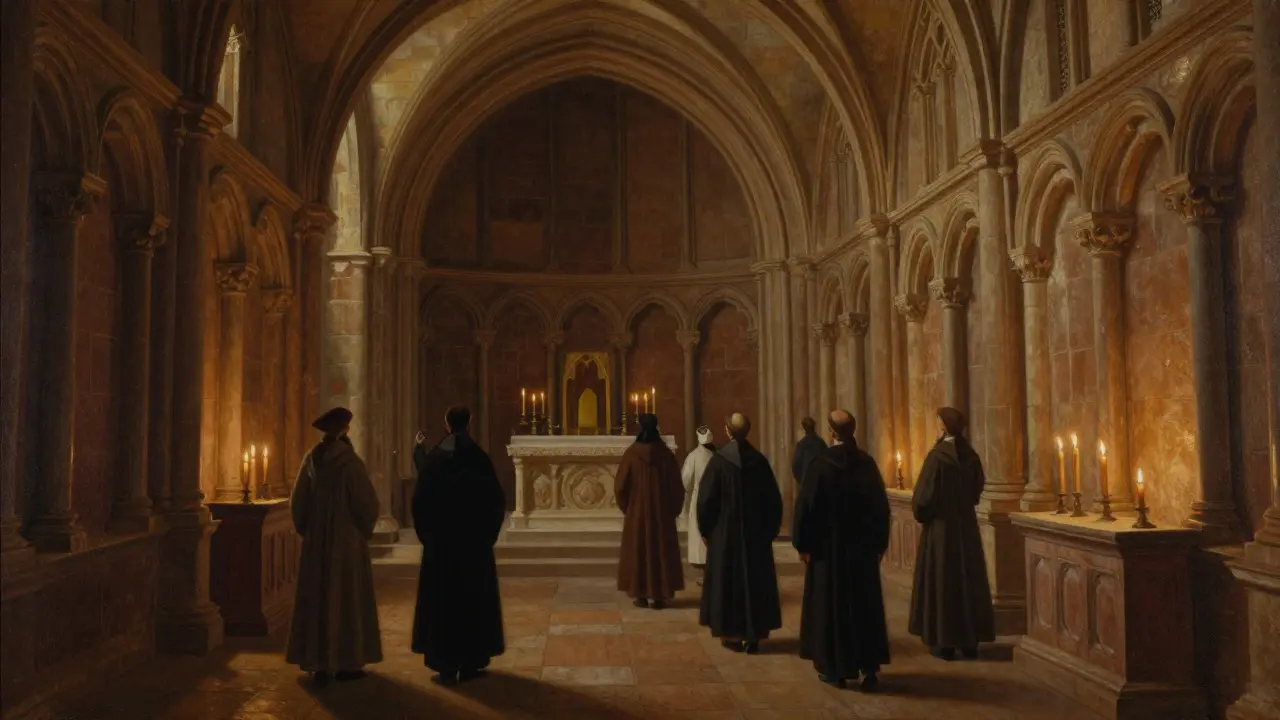
Smaller windows were another signature. With walls this thick, large openings would weaken the structure. Instead, windows were narrow slits or grouped in small clusters. Light came in sparingly, creating a dim, mysterious interior. This wasn’t a flaw-it was intentional. The darkness emphasized the sacredness of the space, with light often coming only from high clerestory windows or candlelit chapels. In contrast, Gothic cathedrals later used stained glass to flood interiors with color, but Romanesque churches relied on shadow and stone for spiritual impact.
Key Features You Can Spot Today
Even if you’ve never studied architecture, you can recognize Romanesque buildings. Look for these telltale signs:
- Rounded arches: Unlike Gothic’s pointed arches, Romanesque arches are semicircular. They’re used in doorways, windows, and arcades inside churches.
- Massive stone walls: These weren’t just decorative. They supported heavy barrel vaults and provided defense against raids.
- Barrel vaults: A continuous, tunnel-like ceiling made of stone. This was the first widespread use of vaulting in Europe since Roman times.
- Small, grouped windows: Often placed high up to avoid weakening walls, with minimal glass.
- Towers and turrets: Many churches had square towers, sometimes paired at the west end. These served as bell towers and lookout points.
Take the Abbey Church of Sainte-Foy in Conques, France. Built in the 11th century, it has all these traits. Its rounded arches frame the nave, while the thick walls support a barrel vault. Pilgrims walking the Camino de Santiago would enter through a heavy wooden door, passing under a sculpted tympanum depicting Judgment Day. This wasn’t just art-it was a warning to sinners and a beacon for the faithful.
How Pilgrimage Routes Shaped Design
Romanesque architecture didn’t develop in isolation. It was driven by one of medieval Europe’s biggest phenomena: pilgrimage. Millions of people traveled to holy sites like Jerusalem, Rome, and Santiago de Compostela. Churches along these routes needed to accommodate crowds, provide shelter, and display relics. This led to innovations like the ambulatory-a walkway around the altar-and radiating chapels. These allowed pilgrims to circulate without disrupting Mass.
The Basilica of Saint-Sernin in Toulouse, France, is a perfect example. Built between 1080 and 1120, it has a 200-foot-long nave with side aisles and five radiating chapels. Its design could handle thousands of pilgrims daily. The church’s thick walls and sturdy vaults also protected relics during raids. Without the pilgrimage boom, Romanesque architecture might never have spread so widely. It was literally built for movement-both spiritual and physical.
Romanesque vs. Gothic: Why the Shift Happened
| Feature | Romanesque | Gothic |
|---|---|---|
| Arches | Rounded | Pointed |
| Walls | Thick, load-bearing | Thinner, supported by flying buttresses |
| Windows | Small, few | Large, stained glass |
| Vaulting | Barrel or groin vaults | Ribbed vaults |
| Height | Relatively low (40-60 feet) | Very tall (100+ feet) |
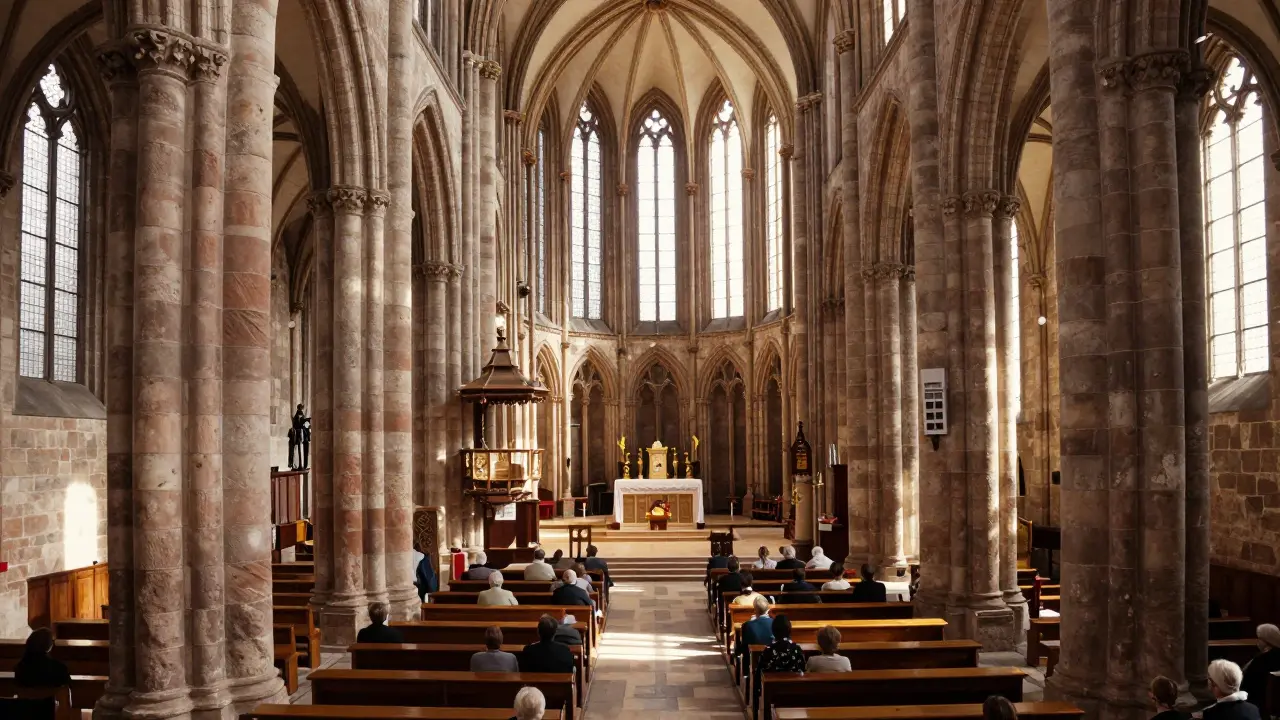
By the 12th century, Romanesque was giving way to Gothic. The reasons were practical and cultural. Builders wanted taller churches with more light-symbolizing divine presence. The key innovation was the pointed arch. Unlike rounded arches, pointed ones directed weight more efficiently, allowing thinner walls and larger windows. Flying buttresses (external supports) took the pressure off walls, freeing them up for stained glass. The Cathedral of Notre-Dame in Paris, started in 1163, shows this shift clearly. Its soaring height and vibrant windows contrast sharply with the solid, earthy Romanesque churches of the previous century.
But Romanesque didn’t disappear overnight. Many Gothic cathedrals began as Romanesque structures, then expanded. Durham Cathedral in England (1093) is a hybrid: its nave is Romanesque with massive pillars and barrel vaults, while later additions use Gothic elements. This shows how the two styles overlapped, with Romanesque laying the groundwork for what came next.
Why Romanesque Still Matters Today
It’s easy to think of Romanesque as "old" or "primitive," but that’s far from true. This style unified Europe when political borders were shifting. A church in Germany looked similar to one in Spain because builders shared techniques and designs. This was the first time Europe had a common architectural language. Romanesque also advanced engineering. Barrel vaults required precise calculations for weight distribution, setting the stage for Gothic’s more complex vaults.
Many Romanesque buildings still stand. The Speyer Cathedral in Germany, built in 1030, is one of the largest surviving Romanesque structures. Its 120-foot-tall nave was a marvel for its time. Even today, it hosts services, proving how durable this style was. In the 19th century, Romanesque Revival architecture brought back rounded arches and sturdy walls for schools, libraries, and train stations. This shows how timeless the style remains.
Common Misconceptions
People often confuse Romanesque with Gothic or even Roman architecture. But Romanesque isn’t just "Roman-style"-it’s medieval innovation. While Romans used concrete and arches, Romanesque builders used stone and adapted those ideas for new purposes. Another myth is that Romanesque churches were all dark and gloomy. While they had fewer windows than Gothic ones, they weren’t pitch-black. Light came from clerestory windows, candles, and the occasional stained-glass panel. The dimness was part of the experience, not a lack of skill.
Also, Romanesque wasn’t static. Regional variations existed. In Italy, churches had more marble and classical details. In Normandy (England and France), buildings featured intricate carvings and larger towers. In Spain, Islamic influences added geometric patterns. This diversity shows how Romanesque adapted to local cultures while maintaining core principles.
What time period does Romanesque architecture cover?
Romanesque architecture flourished from roughly 1000 to 1200 AD. It began in the late 10th century, peaked in the 11th century, and gradually transitioned into Gothic by the mid-12th century. This period coincided with Europe’s economic recovery, the growth of monasticism, and the rise of pilgrimage routes.
How did Romanesque architecture influence later styles?
Romanesque laid the technical foundation for Gothic architecture. Engineers perfected barrel vaults and stone masonry techniques in Romanesque buildings, which later allowed for the taller, lighter structures of Gothic cathedrals. The use of pointed arches and flying buttresses in Gothic directly evolved from Romanesque experiments with weight distribution. Without Romanesque’s innovations, Gothic’s verticality and stained glass wouldn’t have been possible.
Why are Romanesque churches often built with thick walls?
Thick walls were necessary to support heavy stone vaults and withstand attacks in a turbulent medieval world. Unlike Gothic buildings that used external buttresses, Romanesque relied on internal wall thickness to hold up the roof. A typical wall might be 3 feet thick, made from locally quarried stone. This made construction slower but ensured buildings lasted centuries-many still stand today.
Can you name a famous Romanesque building still in use today?
Yes! The Speyer Cathedral in Germany, completed in 1061, is one of the largest and best-preserved Romanesque structures. It’s still an active Catholic church and a UNESCO World Heritage Site. Its 120-foot-tall nave and massive stone vaults showcase Romanesque engineering at its peak. Pilgrims and tourists visit daily, continuing a tradition that began nearly a millennium ago.
Did Romanesque architecture vary by region?
Absolutely. While core features like rounded arches and thick walls were universal, regional differences were striking. Italian Romanesque used more marble and classical columns, reflecting proximity to ancient Rome. In Normandy (modern France and England), buildings featured elaborate stone carvings and large towers. Spanish Romanesque incorporated Islamic geometric patterns due to cultural exchange. Even within regions, local materials shaped designs-granite in Brittany, limestone in Burgundy.